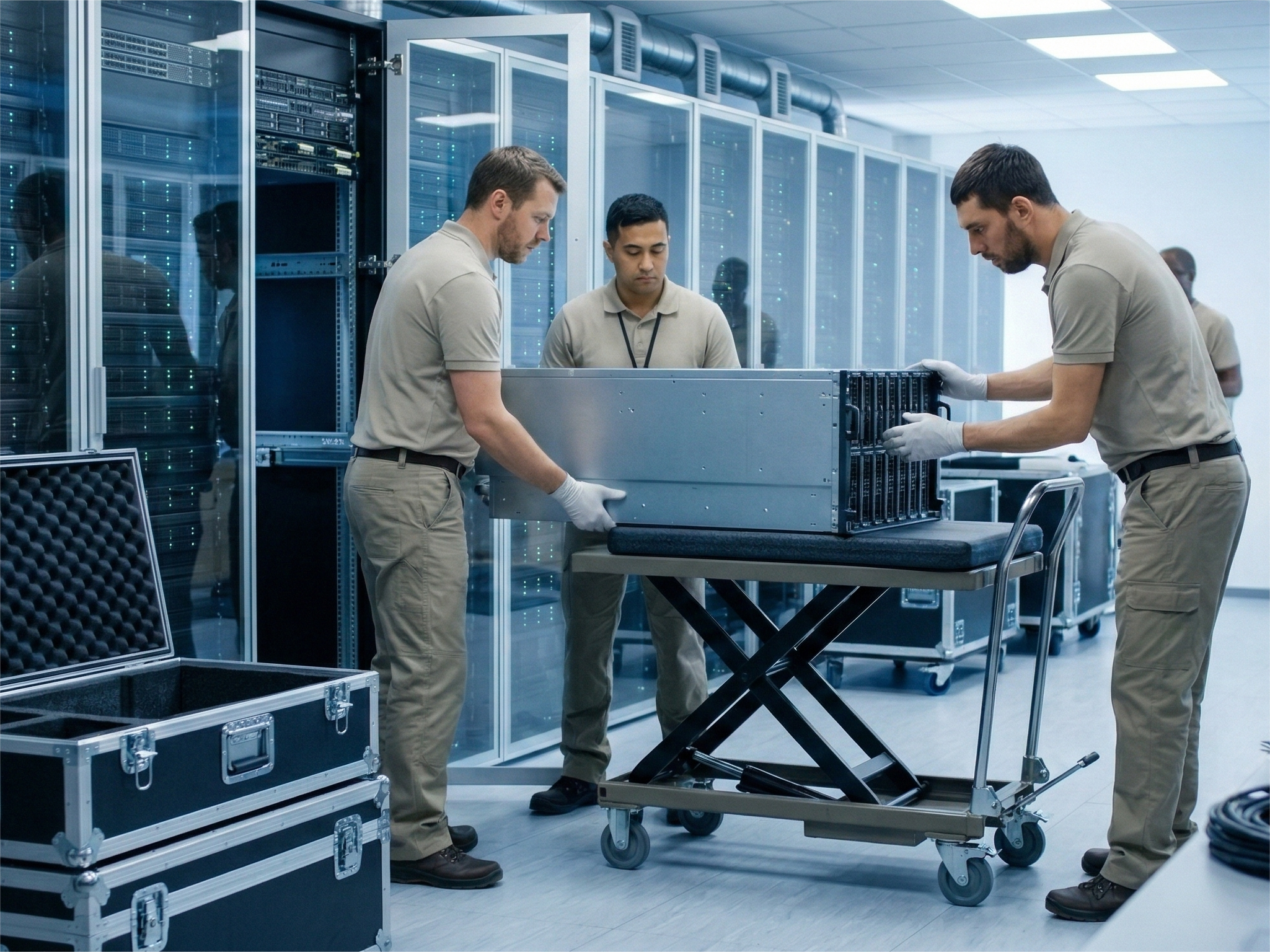

Modern organizations are under constant pressure to evolve. Companies are rethinking how and where critical systems live, due to factors such as:
- Aging infrastructure
- Rising operating costs
- Expanding connectivity requirements
- New security expectations
What once felt stable can quickly become a bottleneck to growth, performance, and agility. That is why data center migration services have become a strategic move for businesses ready to gain efficiency, strengthen security, and unlock improved scalability without sacrificing uptime or data integrity.
A well-planned migration is not just about moving hardware or virtual machines from one location to another. It is a complex process that touches:
- Physical and existing infrastructure
- Applications
- Workloads
- Backup systems
- Security requirements
- Business operations
Every step has the potential to either accelerate progress or introduce costly risk. The difference lies in careful planning, proven processes, and an experienced migration partner who understands how to manage resources, protect sensitive data, and deliver a smooth transition.
Kinettix brings a proactive approach to this challenge. Through a global network of specialized technicians and centralized project management, we support companies that need confidence when migrating from on premises environments to a new facility, a colocation facility, the public cloud, or a hybrid approach.
By coordinating people, hardware, software, and processes under one system, chaos becomes control and complexity turns into a competitive advantage.
When is it Time for Data Center Migration? 6 Critical Trigger Points
Organizations rarely wake up one day and decide to start a new data center or move an existing one without a reason. There are clear business and technical drivers that signal the right moment to begin a migration process.
Recognizing these trigger points helps business leaders and IT teams make informed decisions before small problems grow into operational risks.
-
Facility Lease Expiration or Cost Optimization
When a lease is nearing its end or the cost of maintaining a current facility continues to climb, moving to a new location or colocation facility can create measurable cost savings. Companies can reduce overhead related to power, cooling, security, and space while gaining access to modern infrastructure and connectivity options that better support future growth. -
Technology Refresh and Hardware Upgrades
Aging hardware eventually slows performance, increases maintenance costs, and creates vulnerabilities. Planning a move alongside a technology refresh allows organizations to introduce new systems with improved scalability, better energy efficiency, and enhanced performance, all while consolidating equipment and eliminating outdated components that no longer serve business needs. -
Mergers, Acquisitions, or Corporate Restructuring
When companies combine operations or restructure internal systems, multiple environments often need to merge into one system. Consolidating resources through a migration helps remove redundancy, streamline management, and create a single operating environment that supports collaboration and long-term strategy. -
Disaster Recovery and Business Continuity Requirements
Natural disasters, cyber threats, and infrastructure failure continue to rise in frequency and impact. If current backup systems and recovery plans do not meet modern resilience standards, relocation to a more secure and compliant environment becomes essential. A well-designed move strengthens risk management and protects critical data and operations.
Cloud Adoption and Hybrid Infrastructure Strategies
Many organizations are driven by the need for improved scalability and flexible workload management. A hybrid approach that blends on-premises systems with a virtual data center or public cloud environment allows teams to scale, optimize resources, and support new initiatives without relying solely on a single physical location. -
Connectivity Limitations and Performance Bottlenecks
Outdated connectivity options can prevent access to faster networks and advanced tools. Moving to a new facility or modern cloud-based environment unlocks increased bandwidth, enhanced access, and better support for data-heavy workflows that modern digital transformation demands.
Each of these trigger points highlights a different driving force, but all share one requirement: careful planning guided by an experienced migration partner.
Expert Field Services Solve These 8 Critical Migration Challenges

A move of this magnitude presents challenges that go beyond simple logistics. Without the right planning and field support, even the most prepared organizations risk delays, downtime, and compromised security.
- Maintaining Business Continuity During Migration
Even brief interruptions can impact revenue and customer trust. Field experts use phased execution and off-peak scheduling to support minimal disruption and maintain operational stability.
- Coordinating Multiple Vendors and Contractors
Managing different providers, contracts, and timelines quickly becomes a complex process. A centralized partner takes full ownership, serving as a single point of accountability that aligns efforts and communication.
- Equipment Compatibility and Physical Constraints
Not all hardware fits easily into a new layout. Experienced technicians identify compatibility issues early and plan appropriate rack layouts, cabling, power distribution, and airflow strategies.
- Timeline Delays and Schedule Overruns
Without structured management, unexpected problems can derail an entire project. A defined process, supported by forecasting, tracking, and skilled labor keeps timelines realistic and achievable.
- Geographic Distribution and Time Zone Management
Global companies face added complications when moving systems across regions. Coordinated support teams manage work across time zones and locations while maintaining consistent standards.
- Sensitive Data Protection and Security Requirements
Every step must protect sensitive data. Secure handling protocols, encryption practices, and chain-of-custody tracking guard integrity throughout the move.
- Resource Allocation and Workload Prioritization
Deciding which systems move first requires careful evaluation of business impact. A structured approach keeps critical workloads online while sequentially transitioning less time-sensitive assets.
- Minimizing Risk and Ensuring Compliance
Industry regulations cannot be overlooked. Proactive checks and validations help maintain compliance and significantly reduce risk exposures.
With the right support, complexity is transformed into a controlled, predictable operation.
The 6 Types of Data Center Migration (& the Field Services Each Requires)
The migration landscape includes several strategic approaches, each suited for different business goals. Reordered and refined, the most common types include:
-
Relocation Migration
This involves moving an entire environment from one location to a new facility. It requires precise planning, secure transport of hardware, careful handling of physical infrastructure, and immediate validation at the new site. -
Consolidation Migration
Multiple environments are merged into fewer locations or a single centralized system. This approach reduces cost, simplifies management, and increases efficiency, but requires detailed coordination among hardware, software, and network components. -
Cloud Migration as a Hybrid On-Ramp
Systems are transferred from on-premises infrastructure to a hybrid model that combines physical and virtual data center environments. This supports improved scalability, increased flexibility, and gradual transformation. -
Hybrid Migration
Here, workloads are split between cloud environments and physical locations based on performance, security, and business requirements. It is ideal for organizations needing both control and elasticity. -
Colocation-Based Transition
Infrastructure is moved into a third-party facility that provides secure physical space, connectivity options, and advanced power and cooling. This lowers capital investment while increasing reliability. -
Virtual Transformation Migration
Physical assets are converted into virtual machines, reducing hardware dependency and paving the way for future analysis, automation, and cloud integration.
Each type requires specialized field services, from physical transport and installation to software configuration and system validation.
|
Migration Type |
Locations Involved |
Typical Duration |
Field Tech Complexity |
|
Consolidation |
Multiple → Fewer |
6-18 months |
Very High |
|
Relocation |
Single → Single |
3-12 months |
High |
|
Cloud Migration |
On-prem → Colo/Hybrid |
6-24 months |
Medium-High |
|
Hybrid Migration |
Distributed |
12-36 months |
Very High |
The 7-Phase Migration Process: From Planning to Production

Executing a smooth transition requires a structured process that accounts for every technical and business detail.
- Discovery and Assessment
Teams evaluate existing infrastructure, workloads, hardware, software, dependencies, and current performance. This step identifies risks, inefficiencies, and opportunities. - Migration Strategy and Design
A customized plan is developed, outlining the approach, tools, timeline, security requirements, and key steps necessary to achieve business objectives. - Pre-Migration Preparation
Backup systems are validated, resources are staged, new environments are tested, and staff are briefed to ensure readiness. - Testing and Validation
Simulations and test runs confirm processes work as designed and reveal any issues before live execution. - Migration Execution
Physical and virtual assets are transferred according to a defined sequence that minimizes disruption and protects data integrity. - Verification and Cutover
Systems are validated at the new location or environment, and operations are formally transitioned to the new setup. - Decommission and Cleanup
Obsolete equipment is removed, documentation is updated, and loose ends are resolved to ensure a clean completion.
This disciplined method supports minimal downtime and a smooth transition that aligns with overall business goals.
Why Choose Kinettix for Data Center Migration Field Services?
Kinettix delivers more than support. We provide confidence across every phase of migration.
Our team blends local expertise with centralized management, offering true 24/7 oversight in more than 90 countries. Through standardized processes, our proprietary management platform, and an experienced network of specialists, organizations gain visibility, accountability, and control.
For business leaders, this means faster execution, fewer surprises, improved scalability, and a secure transition that protects operations and sensitive data. If your organization is preparing for a complex move, working with a trusted migration partner ensures the best solution is matched to your business needs.
Ready to replace uncertainty with clarity? Contact Kinnetix today. We’re ready to manage the field, coordinate resources, and deliver results with precision.
Comparing Data Center Migration Service Models: Which Is Right for You?
Organizations commonly evaluate three primary approaches: an in-house team, a general IT contractor, or specialized field services.
In-house teams offer familiarity with internal systems but may lack experience in large-scale, distributed operations. They often face limitations in resources, geographic reach, and availability, which can lead to increased risk and extended timelines.
General IT contractors provide flexibility but vary greatly in quality and scope. Their network, processes, and accountability may not be consistent, especially for large or geographically dispersed projects.
Specialized field services, such as those provided by Kinettix, deliver global reach, standardized execution, and real-time visibility. With on-demand scaling, dedicated management, and strong compliance practices, this approach is best suited for complex, multi-location initiatives where consistency and speed matter most.
|
Approach |
In-House Team |
General IT Contractor |
Specialized Field Services (Kinettix) |
|
Global Coverage |
Limited to your locations |
Depends on contractor network |
90+ countries, guaranteed |
|
24/7 Availability |
Business hours only |
Varies |
True 24/7/365 operations |
|
Resource Scaling |
Fixed team size |
Contract-dependent |
On-demand scaling |
|
Multi-Vendor Coordination |
You manage |
You still manage |
Single point of accountability |
|
Quality Standardization |
Varies by person |
Varies by subcontractor |
Standardized processes |
|
Cost Model |
Fixed salary + benefits |
Project-based |
Flexible (hourly, project, or managed) |
|
Best For |
Single-site, simple moves |
Regional projects |
Multi-site, complex, global migrations |
5 Migration FAQs Answered by Data Center Experts

Before you begin your move, it’s important to understand what to expect at each stage of the process:
- How long does a typical data center migration take?
Duration varies based on scale and complexity, typically ranging from 6 months to several years for large enterprises. - Can you really migrate with zero downtime?
While zero downtime is the goal, most organizations achieve minimal disruption through careful scheduling and phased execution. - What’s included in data center migration field services?
Planning, coordination, hardware handling, software configuration, testing, validation, and ongoing support are all part of the process. - How do you handle migrations across multiple time zones?
Centralized coordination with regional teams ensures continuous coverage, efficient scheduling, and seamless handoff between locations. - What if something goes wrong during the migration?
Risk is minimized through backup systems, contingency planning, and real-time response from support teams.
2 Data Center Migration Success Stories: Real Projects, Real Results
Enterprise data center migrations demand flawless execution across network infrastructure, hardware coordination, and cutover orchestration. These case studies showcase how Kinettix delivers end-to-end migration services that minimize downtime, eliminate costly errors, and ensure business continuity throughout complex infrastructure transitions.
-
Data Center Migration for Publishing Company
A national organization specializing in publishing and media operations manages facilities across dozens of markets. As legacy IT infrastructure began reaching end-of-life, the client encountered multiple operational challenges:
- The need to upgrade and standardize hardware systems across various, often remote, sites to support digital transformation objectives
- Ensuring equipment deployments and service calls were executed efficiently to minimize downtime and avoid disruptions to publishing operations
- Managing the variability of field service needs—from routine maintenance to urgent incident response—without a large internal technical staff
- Requiring detailed documentation and communication for regulatory tracking, stakeholder reporting, and process optimization
Kinettix’s Solution
Kinettix tailored a field service management program to provide seamless, reliable coverage and execution:
- Centralized Service Coordination: All service requests, scheduled projects, and emergency calls were routed through Kinettix’s 24/7 service desk to guarantee rapid triage and dispatch.
- Vetted Technician Network: Drawing from a national resource pool, Kinettix matched qualified technicians to each site’s requirements, considering both skill set and geographic proximity.
- Standardized Execution Protocols: Each deployment task—whether equipment installation, troubleshooting, or site decommissioning—was guided by clear scopes of work and quality assurance checklists.
- Transparent Communication and Reporting: Every service event was tracked in real-time, with work-in-progress updates and detailed closure reports provided to the client’s stakeholders.
Execution
Throughout the project, Kinettix supported a wide range of field service engagements:
- Coordination with each facility’s on-site contact to schedule technician arrival and ensure operational readiness
- Execution of hardware upgrades, system replacements, and network assessments as outlined by the project strategy
- Responsive support for incidents requiring urgent technician dispatch to remedy hardware or connectivity failures, maintaining business continuity
- Uploading of digital documentation (photos, asset details, and test results) to client portals for compliance and reporting needs
End Results
By partnering with Kinettix, the publishing services provider realized significant operational gains:
- Streamlined Upgrades & Rollouts: Sites across multiple markets were updated quickly and efficiently, with minimal disruption to their core publishing operations
- Consistent Service Quality Nationwide: A standardized approach to technician vetting, work instructions, and QA ensured uniform outcomes, regardless of location or scope
- Reduced Downtime & Cost Savings: Fast response and flexible staffing minimized site outages and avoided the expense of maintaining large in-house IT teams
- Improved Stakeholder Confidence: Real-time status updates and comprehensive after-action reports empowered management with visibility into field operations and resource utilization
-
Data Center Migration for a Technology Solutions Integrator
A major technology solutions integrator with a diverse portfolio of enterprise clients required a scalable field services partner to support its large-scale IT deployment and maintenance initiatives. The client faced challenges including:
- Managing simultaneous, multi-location project rollouts for hardware installations, upgrades, and refreshes
- Ensuring consistent service quality and adherence to technical standards across geographically dispersed customer sites
- Maintaining flexibility to rapidly scale resources for project surges or network outages
- Providing thorough documentation, real-time updates, and operational transparency to enterprise clients
Kinettix’s Solution
Kinettix developed and implemented a robust field service solution, engineered for the client’s high-volume and variable project demands:
- Centralized Project Management: A dedicated team coordinated scheduling, resource assignment, communication with stakeholders, and escalation for incidents, ensuring seamless execution regardless of project size or complexity.
- Extensive Technician Network: Leveraging a vetted and flexible pool of skilled field engineers across the country, Kinettix ensured all work orders were assigned to certified technicians with appropriate expertise.
- Standardized Quality Protocols: Work instructions, pre-installation surveys, and QA checklists ensured installations, upgrades, and troubleshooting were performed to the client’s technical standards—delivering consistent outcomes at every site.
- Integrated Tracking and Reporting: Using digital work order management tools, all activities were tracked from dispatch through to completion, providing real-time status updates and comprehensive after-action reports to both the client and its end-customers.
Execution
During the project,, Kinettix supported hundreds of project sites with a full suite of IT hardware and infrastructure services:
- Pre-Deployment Site Assessments: Technicians conducted site readiness surveys to pre-empt deployment challenges, confirm requirements, and document baseline conditions.
- Hardware Installation & Upgrade Services: Field engineers installed, configured, and tested servers, workstations, network appliances, and peripheral devices according to strict SOWs and technical guidelines.
- Rapid Response and Maintenance: Kinettix provided flexible scheduling for urgent needs—including after-hours and weekend dispatch—to minimize end-user downtime and maximize project velocity.
- Documentation and Client Handoff: Digital records (including photos, validation test results, and customer acknowledgments) were submitted for each work order, delivering transparency and audit trails for compliance.
End Results
Kinettix’s partnership enabled the technology solutions integrator to achieve key strategic and operational outcomes:
- Accelerated Deployment Timelines: Coordinated project management and resource scaling allowed for rapid completion of complex, multi-site deployments—meeting tight client deadlines and SLAs.
- Uniform Service Quality Nationwide: Consistent execution through standardized protocols increased end-customer satisfaction and reduced follow-up service calls.
- Operational Flexibility: The client could scale field resources up or down in real time, optimizing costs while meeting variable demand.
- Enhanced Transparency: Comprehensive real-time reporting empowered both the integrator and their enterprise clients with the visibility needed for proactive issue resolution and strategic planning.
- Long-term Partnership Success: Reliable service delivery and clear communication established Kinettix as a trusted field operations partner, supporting ongoing and future client initiatives.
Confidently Execute Your Migration: Partner with Data Center Migration Experts

A successful move needs more than technology. It requires best-in-class:
- Strategy
- Coordination
- Precision
- Trust
With so many moving parts, organizations need a true partner who can manage the entire process while protecting operations and unlocking new opportunities.
Kinettix provides the expertise, tools, and global support required to guide your organization through every stage. From careful planning and risk reduction to secure execution and final validation, their team ensures your transition remains smooth, controlled, and aligned with your long-term vision.
If your business is preparing for a new location, a hybrid approach, or a modern cloud-based future, now is the time to act. Connect with Kinettix and start building a secure, scalable path forward with confidence.