

Field Nation is a labor marketplace, so its alternatives fall into three models based on who finds the technician and who coordinates the work: a labor platform, field service software, or a managed provider. Kinettix is a managed provider, which means it takes on both steps and owns the outcome of each site visit.
Failed visits account for 25% of total service cost at the median organization, per Aquant's 2026 benchmark of 161 organizations, so the model you pick largely decides who absorbs that cost. This guide compares five alternatives, says where each one wins, and lists what to check before you switch.
The three models look like this:
- A labor platform, which gives you access to their own network of technicians
- A field service software provider, which gives your own team a software system design to augment your existing staff
- A managed provider, which provides both technical and strategic support. This is where Kinettix operates.
We've done the work of sorting several Field Nation Alternatives by who finds the technician and who coordinates the work, then compared each model against government labor data, published benchmarks, and our own 2023 project records. Where a model wins an axis, the comparison says so.
Why Do Buyers Look for Field Nation Alternatives? What Reviewers Praise & Flag
Field Nation has a very strong G2 profile, with a rating of 4.5 out of 5 across 409 reviews, so the case for leaving rarely starts with dissatisfaction. Even a strong platform can come up short if a given program expands beyond a labor-platform model. The counts below are G2's all-time mention tallies as of October 2026.
|
Reviewers praise (mentions) |
Reviewers flag (mentions) |
|
Ease of use (35) |
Improvement needed (15) |
|
Customer support (16) |
High fees (7) |
|
Efficiency (14) |
Technical issues (6) |
|
User-friendly (13) |
Delays (5) |
|
Platform usability (9) |
Difficult navigation (5) |
The pressure to find the ideal technician provider is far more widespread than just a single platform. In ManpowerGroup's 2026 survey of 39,063 employers in 41 countries, 72% reported difficulty filling roles (69% in the U.S.).
3 Models Behind Every Field Nation Alternative: Which 1 Do You Need?
Between a labor platform, field service software, or managed provider, the difference decides who absorbs the cost of a failed visit. That difference decides who absorbs the cost of a failed visit.
That split explains the three models. A labor platform sells access to the contractor pool, and you find the technician and coordinate the work. Field service software gives your own team a system, and a managed provider takes on both steps and owns the outcome.
|
|
Labor platform |
Field service software |
Managed provider |
|
What you get |
Access to technicians |
A system for your own team |
Ownership of the outcome |
|
Who finds the technician |
You |
You (your employees) |
The provider |
|
Who coordinates the work |
You |
You |
The provider |
|
Examples |
Field Nation, WorkMarket, FieldEngineer |
ServiceTitan, Agentforce Field Service |
Kinettix |
Where each model wins: a labor platform usually costs less per labor hour and gives you direct control over who you hire, and it is the fastest way to post one-off work. A managed provider wins where failed visits and multi-site consistency are the problem. If you run a few sites with in-house dispatchers, a platform is likely the better fit.
How Do 5 Field Nation Alternatives Compare Across the 3 Models?
Each entry below covers how the model works, what proof to request, and who it fits. Aquant puts the industry first-time-fix rate at 77%, with top performers at 88% and bottom performers at 60%, so ask every vendor for first-visit numbers you can hold against that range.
Field Nation: Labor Platform
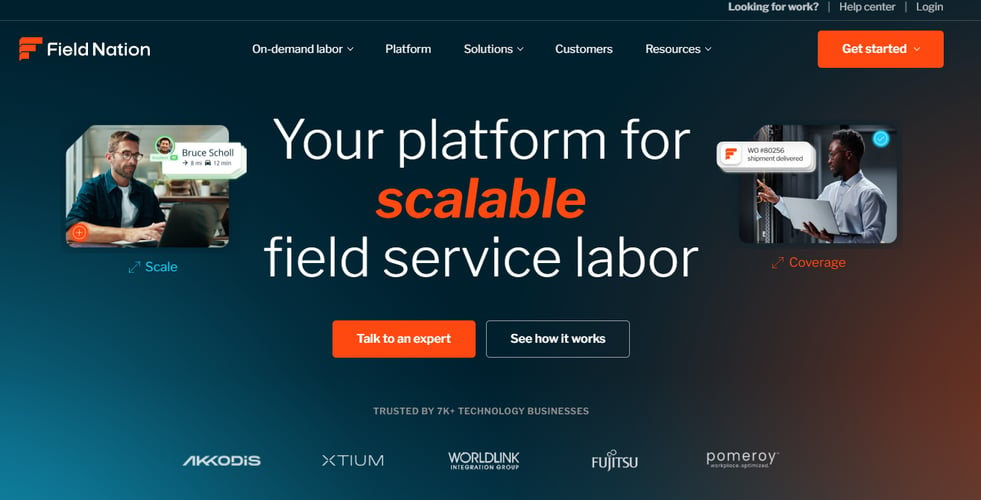
- How it works: Field Nation is a labor marketplace: in its standard plans, you find the technician and coordinate the work. Its Premier tier adds talent sourcing services, including managed recruitment, and a dedicated expert team, so ask what is included at your plan level. You pay through a subscription plus processing fees, with savings at spend milestones.
- Published proof: Ask for first-visit completion and technician no-show rates for your regions and work types. Ask how each rate is measured, so you can compare it with other vendors.
- Best fit: Teams with dispatchers who want to post work, choose technicians, and approve each order themselves. Volume matters here, because the discounts reward steady spend.
WorkMarket (ADP): Labor Platform for Your Own Contractor Pool
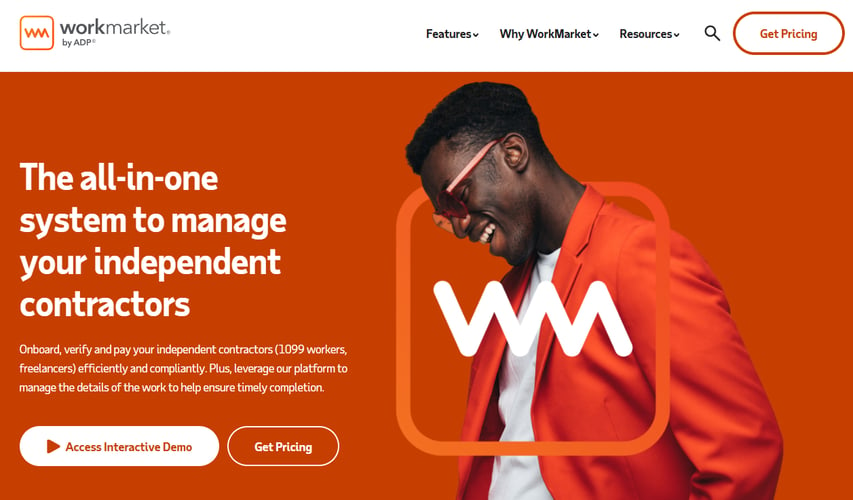
- How it works: WorkMarket is a labor platform built around a contractor pool that you bring or build yourself. You find and coordinate the contractors, and the platform supplies the system to onboard and manage them.
- Published proof: Ask for references from companies running a pool of similar size and work type. Ask what compliance records the platform keeps for each contractor.
- Best fit: Companies that already have a roster of trusted third-party technicians and want one system to manage it. The model rewards buyers who have done the recruiting work already.
FieldEngineer: Global Labor Marketplace
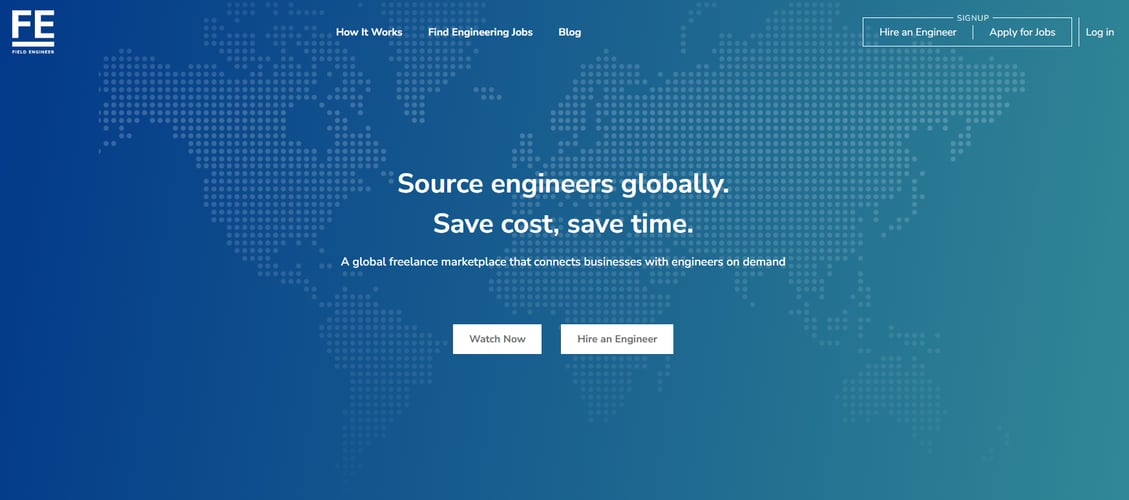
- How it works: FieldEngineer is a global labor marketplace: you post the job, and the marketplace matches engineers and holds payment in escrow. The fee falls on the technician side, and posting is free.
- Published proof: Ask for engineer counts in the countries where your sites sit. Ask how technician rates adjust when the fee comes out of their pay.
- Best fit: Buyers who need short-notice or one-off coverage across many countries and are comfortable coordinating each job themselves. Free posting makes it easy to test coverage in a new market.
ServiceTitan: Software for Your Own Technicians
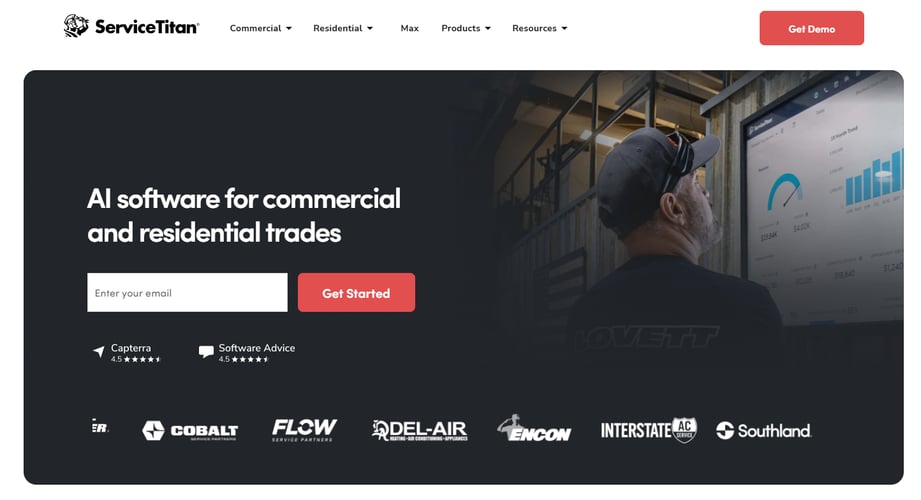
- How it works: ServiceTitan is field service management software for companies that employ their own technicians. You pay a per-user subscription for the system, not the labor.
- Published proof: Ask for implementation timelines and customer references at your technician headcount. Ask for the full price in writing, including onboarding.
- Best fit: Companies that employ their technicians and want one system to run scheduling and dispatch. Because the buyer supplies the labor, it pairs with a labor source rather than replacing one.
Agentforce Field Service: Software for Your Own Technicians
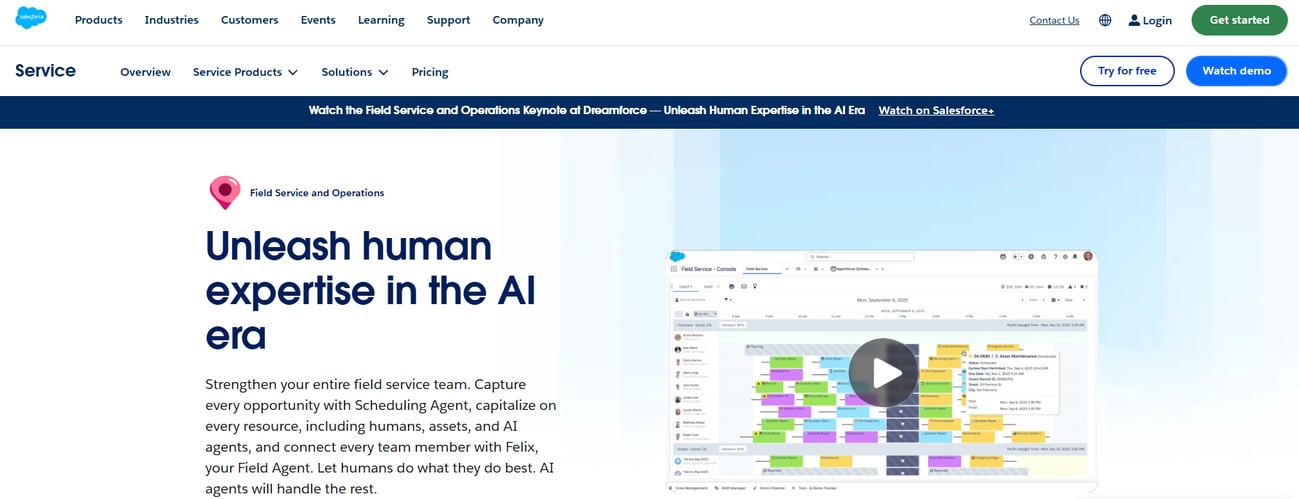
- How it works: Agentforce Field Service is Salesforce's field service software for companies that employ their own technicians. As with the other software option, you pay a per-user subscription for the system and supply the labor yourself.
- Published proof: Ask for references from teams already running Salesforce. Ask which of your current systems need new integrations.
- Best fit: Organizations already built around Salesforce that want field service scheduling inside that environment. Because the license is per user, cost tracks the number of people on the system.
Kinettix: Managed Provider for Multi-Site Programs

- How it works: Kinettix is a managed field services provider that deploys, repairs, and supports technology at distributed sites through a vetted network of local technicians and project managers. Kinettix sources, vets, and schedules the technicians, briefs them before each dispatch, and tracks every request in its Dispatch1 platform.
- Published proof: On a 75-store WAN circuit and router rollout, Kinettix finished with a 93% first-time visit success rate (Kinettix case study, 2023). Aquant's 2026 benchmark puts top performers at 88% first-time fix, but that measures break/fix cases rather than scheduled install visits, so treat it as context, not a ranking.
- Best fit: IT directors and operations leaders running rollouts, refreshes, and break-fix across many sites who want one team accountable for each visit. Kinettix covers on-site and remote work under the same project coordination.
How Is Each Option Priced? 4 Pricing Models Behind Field Nation Alternatives
There are four predominant pricing models across Field Nation alternatives (see table below), and they charge for three different things: access to technicians, the system, or coordination.
Coordination has a greater impact than one might think at first. Aquant's 2026 benchmark found that 1 in 5 service cases could be resolved remotely, yet many teams still send a truck, which turns a 1.4% service cost impact into 18.3%.
|
Pricing model |
Used by |
What you pay for |
What to ask |
|
Subscription plus processing fees |
Field Nation |
Platform access; volume discounts |
What replaces savings at lower volume? |
|
Fee on the technician side; free to post |
FieldEngineer |
Marketplace matching; escrow |
How do technician rates adjust? |
|
Per-user software subscription |
Field service software |
The system, not the labor |
Who supplies the technicians? |
|
Managed coordination |
Kinettix |
Per unit, hours billed with no minimum, or a prepaid monthly team (as in published projects) |
What's labor vs. coordination? |
Platforms and software only charge for access, so you get only the labor or system you pay for and after that, it's up to you to bring the project together and carry the failed-visit risk yourself. A managed provider prices the result, which makes cost per completed visit the number to compare.
Not Sure Which Model Fits Your Field Work? Contact Kinettix for Guidance
These models aren't necessarily mutually exclusive. In fact, most programs mix models in some way to draw benefits from multiple buckets: few high-volume sites that need a standing team, a long tail of one-off tickets, and an in-house crew that handles the rest. Matching each piece to the right model before you sign makes the first contract easier to get right.
Kinettix can review your site list and tell you which model fits each part of the program. Contact us now and you will get a straight answer on which model fits with your site count, locations, and the type of work involved.
What Does a Managed Outcome Look Like? 5 Kinettix Projects, by the Numbers
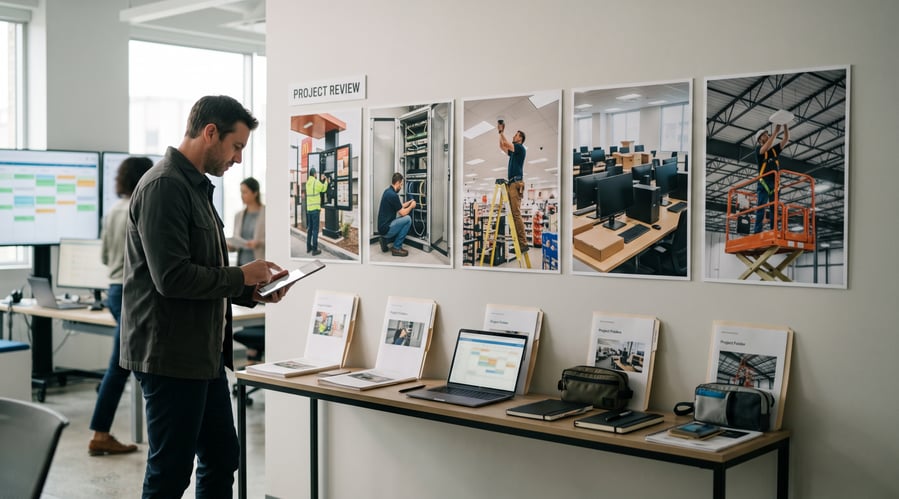
Five Kinettix projects show what a managed outcome looks like when the provider owns the schedule, the technicians, and the closeout. Every figure below comes from a Kinettix case study published in 2023.
- Drive-thru menu boards: A digital merchandising provider relies on Kinettix to install, repair, and replace drive-thru menu boards at a global fast food chain's U.S. restaurants, with an IT technician, an electrician, and a project coordinator at each dispatch. Weekly requests grew from 5 to 6 to more than 20, which Kinettix attributes to consistent results and quick response times.
- WAN circuit & router cutover: A grocery chain with more than 159 stores in 20 states needed a 75-store install finished in 3 months, and Kinettix took over the program. Pre-check calls 24 hours and 1 hour before each visit and a Wi-Fi hotspot for each technician helped Kinettix close at 93% first-time visit success.
- Remote install support: A remote installation engineer team supported field technicians as the project grew from 200 traffic counting cameras at 100 locations to more than 800 installs in 5 weeks, covering 20 to 25 sites a day. The team's call log shows 1,623 total calls with a 26-second average time to answer, billed per camera install supported.
- Windows 10 PC rollout: A rollout that started as 6,000 units over 5 months became 4,500 units over 14 weeks across a main campus, remote locations, and individual shipments, using technicians sourced through nationwide platforms. Kinettix supplied an on-site operations manager, remote project managers billed at actual hours with no minimum, and a prepaid monthly team of 2 to 4 project coordinators.
- Mexico plant access points: At a Saltillo assembly plant, Kinettix LATAM Country Manager Willebaldo Carmona led a team of 10 engineers and technicians through wireless site surveys and lift rentals for ceilings 5 to 6 meters high. The team worked 12-hour days, seven days a week, finished on budget and on deadline, and tested all 65 access points before leaving the site.
6 Items to Check Before You Switch From Field Nation
Independent contractor classifications are continuously changing, so it's essential to keep up with what is and isn't covered by the U.S. Department of Labor's definitions. In 2024, their independent contractor rule replaced a 2021 rule, and a February 2026 proposal would rescind the 2024 rule and replace it with an analysis modeled on the 2021 rule.
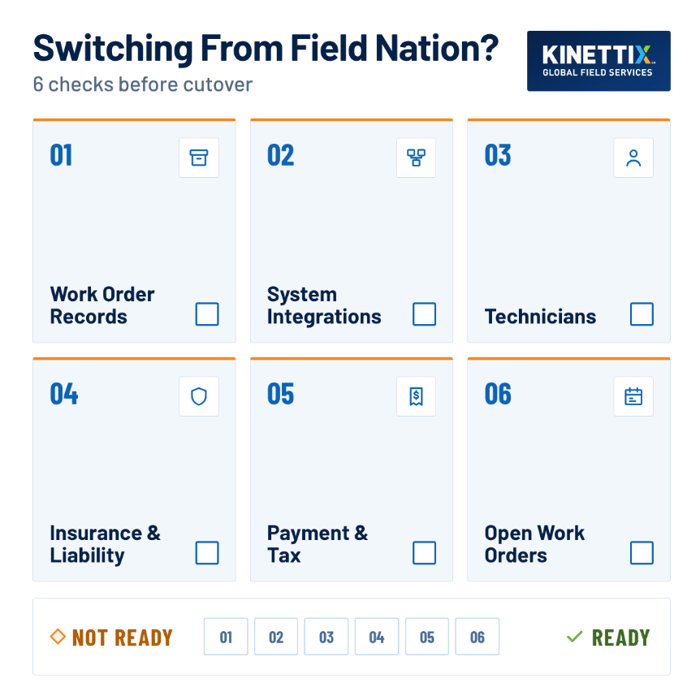
- Work order history & documents
Export your work order history, completion documents, sign-offs, and photos from Field Nation before you move any program. You will need that record for warranty claims, audits, and briefing the next provider on what was done at each site.
- Integrations
List every system that sends work to Field Nation or reads data from it, such as ticketing, ERP, and reporting tools. Confirm which of those connections each alternative can replace before cutover, and who builds and maintains the replacements.
- Technician relationships & platform terms
Read the platform terms before you ask a technician you trust to follow you to a new provider. The Bureau of Labor Statistics found that 80.3% of independent contractors prefer their arrangement over traditional employment, so expect technicians to weigh where they take work and plan for some not to follow.
- Insurance & liability coverage
Ask every provider on your shortlist, Kinettix included, for certificates and coverage limits in writing, with the named insureds, before the first dispatch. Compare what each model covers for property damage, personal injury, and technician injury on your sites.
- Payment & tax handling
Ask who pays the technician, who issues the tax forms, and who answers a classification question under your next model. The Economic Policy Institute cites estimates that 10% to 30% of employers misclassify workers as independent contractors, so get the answer in writing.
- Work orders in flight
Set the cutover by site, and let every open or scheduled work order close on Field Nation first. A rollout moved mid-week risks double-booked or missed sites.
Is Field Nation a Staffing Company? 5 Questions About Its Alternatives, Answered
Here's our rundown on the details of Field Nation's offerings and how they relate to the rest of the industry. We also cover details about some of their competitors and the logistics of managed technicians.
- Is Field Nation a staffing company or a marketplace?
In this comparison Field Nation is a labor platform, which sits closer to a marketplace than a staffing firm: in its standard plans, you find the technician and you coordinate the work, so you buy access rather than a placed workforce. The Bureau of Labor Statistics counts the two labor sources separately, and independent contractors outnumbered workers provided by contract firms by roughly 14 to 1 in July 2023 (11.9 million versus 862,000).
- Can a managed provider work alongside a labor platform?
Yes. On a Windows 10 rollout, Kinettix's project team used technicians sourced through nationwide platforms while Kinettix supplied the operations manager, remote project managers, and coordinators. The split works when the platform supplies labor and the provider supplies schedule control, reporting, and escalation.
- Who carries insurance & liability when a technician is on site?
It depends on the model and the contract, so get it in writing. On a labor platform you engage independent technicians yourself, so confirm whose certificates apply to each work order; with software, your own coverage applies to your own employees; with a managed provider, request the provider's certificates and named insureds.
- What happened to OnForce?
OnForce was a freelancer management system for field service that Adecco Group acquired in 2014 and WorkMarket acquired from Adecco in 2017, according to the company's history on Wikipedia. WorkMarket is now an ADP company, so OnForce's lineage sits with WorkMarket rather than Field Nation. Anyone who still references OnForce should check which current platform they mean.
- Do I have to leave Field Nation completely?
No. Many programs keep a labor platform for one-off tickets and add a managed provider for multi-site programs, as the model mix above describes.
Who Is Accountable When a Site Visit Fails? Settle That Before You Pick an Option
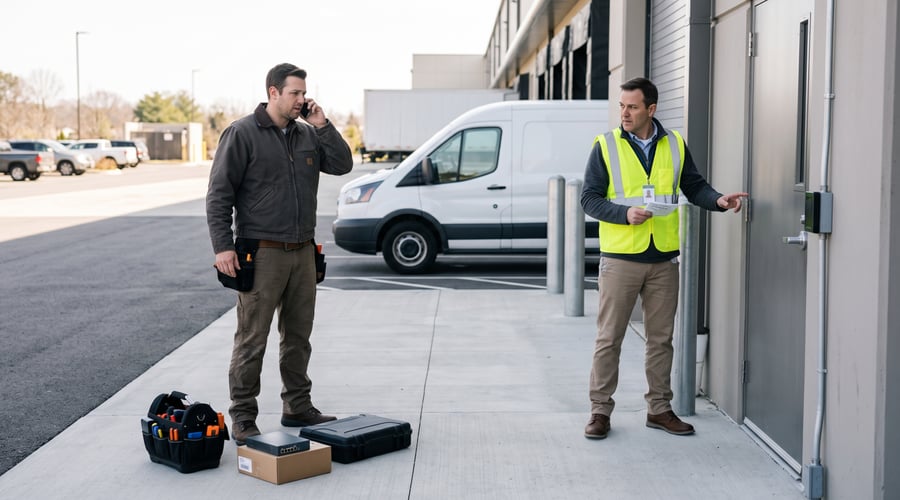
Failed visits take a very different share of cost depending on who runs the operation: Aquant's 2026 benchmark of 161 organizations puts them at 14% of service cost for top performers and 44% for bottom performers.
Who absorbs that cost depends on the service model. A labor platform leaves it with your company and software leaves it with your team, but a managed provider is the model built to own it and handle the fallout for you.
Reach out now with your site list and your current vendor's first-visit numbers. We'll take a look with you and compare the answers side by side.