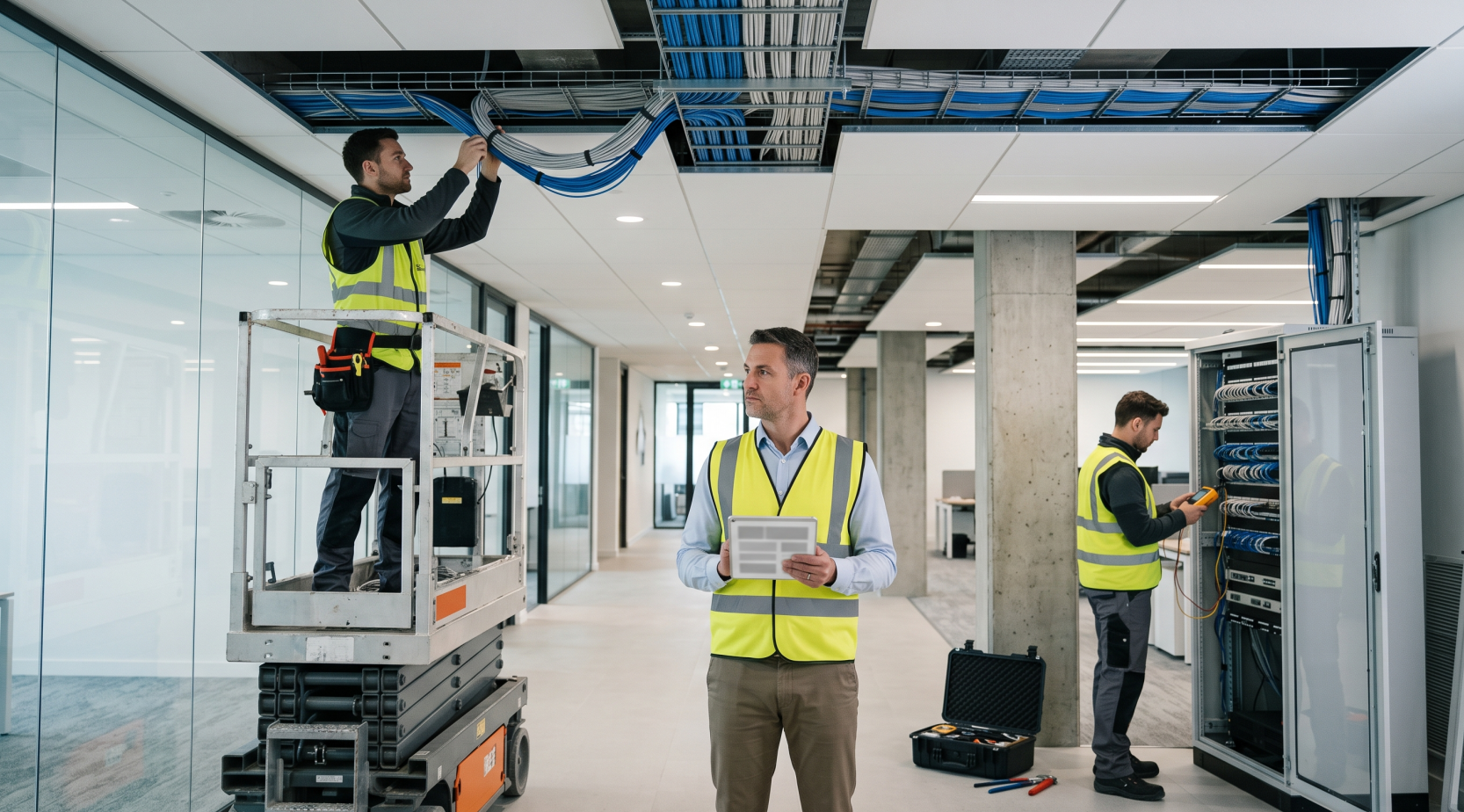
A low voltage installation company runs, terminates, tests, and documents the cable behind data networks, security cameras, access control, and AV systems. That cable now outlives what it connects: the Security Industry Association's 2026 Security Megatrends report describes a five-year refresh cycle for security technology, down from the 10 to 15 years or more that was common.
Kinettix is a global IT field services provider and a BICSI member that specializes in multi-site deployments, including low voltage and structured cabling across state lines. One project manager sequences every site, and every site follows the same work package and closeout record, as in the multi-site industrial security program described below.
This guide covers the four rules that change at state lines (license class, permits, code edition, and the definition of low voltage itself), a five-question test for choosing a local crew or a national partner, and the seven standards to write into a multi-site contract.
What Counts as Low Voltage Work on a Commercial Site?
As seen in a contractor solicitation from the University of Central Florida, the scope of low voltage work is more than just small wires. A low voltage technician is qualified to operate on structured and IP surveillance cabling, sound masking, digital signage, PoE lighting, wireless access points and integrated AV. For more detail on any of these aspects, here's our list of the low voltage workload:
- Structured cabling and fiber
Structured cabling is the organized system of copper and fiber optic cable, patch panels and server rooms that every other low voltage system depends on. Cat6 and Cat6A cover most office and store data cabling, while fiber optic cabling handles backbone runs between closets and buildings.
- Wireless access point cabling
Most wired access points connect over a network cable that also delivers Power over Ethernet, and placement comes from a wireless site survey. Cable runs go to the surveyed position so coverage matches the design.
- Security and surveillance cabling
A wired IP camera system typically uses a home-run Cat6 or Cat6A cable from the closet to each camera, within the 100-meter channel limit, plus switch capacity and PoE budget at the closet.
- Access control and intercom wiring
Readers, door controllers, locks and intercoms each need their own cable type and a pathway to the door frame. Correct access control wiring at install prevents callbacks when a door fails to unlock.
- AV and conferencing wiring
Conference rooms and training spaces need HDMI, audio and network runs terminated to a consistent standard. A consistent connector and labeling choice lets the next technician troubleshoot the room without redrawing it.
- POS, kiosk and menu board drops
Checkout lanes, self-service kiosks and drive-thru menu boards each need a dedicated, labeled data drop at a fixed location. Repeating the same retail technology drop layout across stores lets a rollout team install from a template.
4 Rules That Change When Low Voltage Work Crosses State Lines
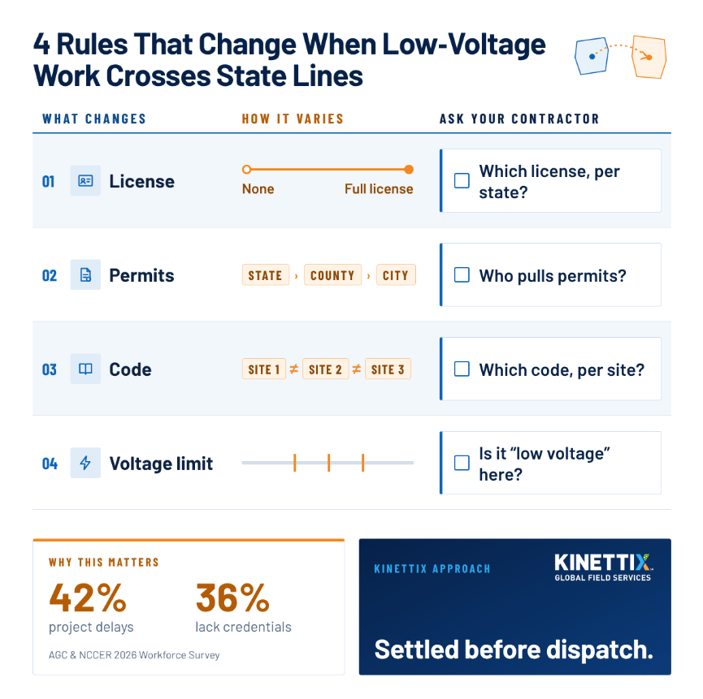
Even where one state has no restrictions, that says nothing about the next one. NSCA's Guide to State Licensing (updated 2023) describes requirements that range from nothing to a full electrical contractor's license. Illinois, Indiana and Kansas, for example, have no general statewide low voltage license, so the rules in the state come from individual cities and counties plus separate fire alarm licensing.
Credentials are a hiring bottleneck across construction: in the AGC and NCCER 2026 workforce survey, 42% of firms reported project delays from worker shortages and 50% said available candidates lack the skills or the certificate or license the job requires. A low-voltage contractor that cannot name the license, permit owner and code edition for each state on your list will leave you to find out at the first failed inspection.
|
What changes |
How it varies |
What to ask a company |
|
Contractor license class |
From no statewide requirement to a full electrical contractor license |
Which license covers this work in each state on my list? |
|
Local permits and inspections |
Can differ by county or city, even inside one state |
Who pulls permits and schedules inspections at each site? |
|
Code and cable-rating requirements |
Adopted code editions and cable ratings vary by jurisdiction |
Which code edition applies at each site? |
|
Definition of "low voltage" |
Thresholds differ by jurisdiction |
Does my scope fall under low voltage rules at each site? |
Use the table as a pre-bid checklist and ask each question once per state on your site list. Kinettix builds these answers into project planning and site surveys so they are settled before a technician is dispatched.
Local Crew or National Low Voltage Installation Company? 5 Questions To Consider
The right choice depends on how many sites you have and how alike they must be. For one building or one metro area, a local contractor knows the inspectors, the building managers, and the quirks of the market, and will often quote lower than a national program. The same scope at 15 locations across the country is where a program with one project manager starts to earn its cost.
Once a rollout spans several states, a national low voltage installation company pulls ahead. When every location must match and go live in the same window, coordinating dozens of local crews means dozens of methods, record formats, and escalation paths.
|
Question |
Points toward a local contractor |
Points toward a national company |
|
How many states are involved? |
One metro area or state |
Several states |
|
How tight is the schedule across sites? |
Sites can be done in sequence |
Sites must run in parallel |
|
How uniform must the result be? |
Each site can follow its own methods |
Every site needs the same standards and records |
|
Who needs to see progress? |
One site contact |
Program-level reporting across all sites |
|
How much local knowledge does the work need? |
Heavy (local codes, building relationships) |
Moderate, with permits and inspections handled per site |
If three or more rows point right, plan for a national partner; if most point left, a local crew will likely serve you well. Kinettix works in both models, using local technicians in each region under one project manager.
What Should Be Identical at Every Site? 7 Standards to Lock Into a Multi-Site Contract

Uptime Institute's 2025 outage analysis found that nearly 40% of organizations had a major outage caused by human error in the past three years, and the overwhelming majority of those involved ignored or inadequate procedures. That research covers data centers, not cabling, but the mechanism carries over: a written standard that gets checked the same way at every site.
These are the seven standards worth writing into a multi-site statement of work:
- Cable category, labeling and naming convention
Specify Cat6 or Cat6A, the connector type and the exact label format (room, panel and port) for every site. One naming convention lets a technician in one state troubleshoot a closet installed in another.
- Pathway, mounting and cable management methods
Set rules for conduit, J-hooks, trays, bend radius and mounting hardware, and require the same patch panel and rack layout everywhere. Pathway choices also drive cost, so the contract should state which method applies when a site has no existing conduit.
- Pre-visit access plan and readiness check
Require a documented access plan (escorts, badge rules, work hours) and a readiness check of ports, PoE capacity and mounting surfaces before the crew arrives. In Kinettix's multi-site Verkada program, access plans were confirmed before each visit and the same readiness checklist ran at every site.
- Test and certification results format
Ask for 100% certification testing of copper links and fiber testing with OLTS and OTDR where fiber is installed, delivered in one file format. The University of Central Florida's 2026 structured cabling solicitation specifies these tests and requires deficiencies to be corrected.
- Photo and as-built documentation
Require dated photos of each pathway, rack and device location, plus as-built drawings that show where every cable ends. Photo records let your team audit a site remotely instead of traveling to it.
- Exception reporting
Define what counts as an exception (blocked pathway, failed link, missing power) and who is notified when one occurs. In the Verkada program, exceptions were documented and routed for follow-up instead of being absorbed into inconsistent installs.
- Closeout package
Name the closeout deliverables in the contract: test results, labeled photos, as-built drawings, the exception log and warranty documents. Tie payment milestones to delivering them.
Have a Site List & Looming Deadline? Find a Trusted Partner Who Delivers
Even if all you have is a site list and a deadline, that's enough to start scoping out your project. Kinettix is a BICSI member that's been coordinating cabling projects and organization-wide rollouts since 2016.
Reach out now with your addresses, the systems in scope, and your target dates, and we will help you craft a plan that shows who covers each site and in what order.
5 Business Benefits of 1 Accountable Partner Across Every Site

Handoffs between teams are where site details and scope get lost. One accountable partner shortens that chain: a single project manager owns the schedule, and every site reports in the same format. Five parts of the program do that work:
- One accountable contract
One statement of work defines scope, standards and closeout for every site, so one party answers for the schedule. That closes the gap where a cabling vendor, a camera installer and a general contractor each point at someone else.
- One schedule across states
A central project manager sequences all sites and moves technicians when a site slips, so a single delay does not stall the program. Kinettix's structured cabling services page lists flexibility with schedule changes and 24/7 coverage across 120+ countries.
- The same records at every site
Test results, photos and as-builts arrive in the same format from every site, which makes comparing sites and approving closeout faster. In the Verkada case study, uniform closeout records let customer stakeholders compare sites and confirm readiness.
- Live status updates through Dispatch1
Dispatch1, the Kinettix dispatch platform, syncs status updates, ETAs, technician notes, photos and closure data back to your team. Project leads can see where each site stands without waiting for a weekly report.
- Technicians and electricians scheduled together
Where a site's rules call for a licensed electrician, the program schedules the electrician and the cabling technicians as one visit plan. That keeps permits, rough-in and device installation in the right order.
Case Study: How 1 Industrial Operator Got the Same Install Standard at Every Site
Kinettix modernized a multi-site industrial operator's physical security infrastructure across several of their locations, without disrupting any of their operations.
Its sites differed in layout, network readiness and legacy infrastructure, so they needed us to develop an installation process that could be replicated across all of their locations without compromising on uniform coverage expectations, predictable quality, and consistent documentation.
- Framing
Rather than treating each location as a one-off, Kinettix ran the work as a program of repeatable work packages. Project managers with Verkada technical certifications led the installs, and every site followed the same five steps.
- The 5-step site package
Every site followed the same sequence, which gave each location the same baseline of diligence even when local constraints differed. The steps map directly to the standards earlier in this guide.
- Pre-visit planning and access coordination. Kinettix set site access plans and confirmed logistics before the visit. Delays at the door, such as missing escorts or unclear entry rules, were handled before they could hurt the schedule.
- Onsite readiness validation. Technicians ran the same checklist at every site: network connectivity and port availability, power and PoE readiness, mounting surfaces and cable routing. Standard checks reduced the chance of partial installs.
- Installation with standardized methods. Secure mounting, clean cable management and clear labeling followed common placement principles. The finished install looked and performed the same way from facility to facility.
- Functional testing and verification. Kinettix checked that each device was stable and ready for operational use after power-up. That cut the risk of revisits for preventable setup issues.
- Closeout documentation and handoff. Each site closed with the same documentation, covering work completed, validation steps and open exceptions. The records gave support teams notes to maintain and scale the deployment.
- Where sites differed
Sites did differ. Some had insufficient network readiness, inaccessible mounting areas or unexpected cabling limitations, and without a standard readiness process those surprises tend to force rework, reschedules or partial completions. Instead of letting technicians improvise, Kinettix documented each exception, routed the follow-up and kept the standard install intact.
Central coordination handled scheduling, site contact engagement and expectations, so sites did not interpret requirements differently. For any low voltage cabling contract, the takeaway is that exceptions need a reporting path from day one.
- The closeout package
Standard closeout records let the customer's stakeholders compare sites, confirm readiness and plan future rollouts. Each package held four items.
- Work completed and areas addressed. The record states what was installed and where. Stakeholders can match it against the scope for that site.
- Validation steps performed. The package shows how each install was verified. That answers the audit question before anyone asks it.
- Exceptions, constraints and dependencies. Open items stay visible, with follow-up routed to an owner. Nothing is absorbed into an inconsistent install.
- Notes for support teams. Technicians leave notes that help support teams maintain and scale the deployment. The next site visit starts from the previous record.
- Final results
The customer gained a repeatable deployment blueprint, because each site followed one lifecycle from readiness to closeout and the rollout could expand without reinventing the process. Standard installation methods and verification steps made quality more predictable across facilities, with less variation in workmanship, placement and post-install troubleshooting.
Readiness validation surfaced infrastructure gaps early, so they were handled as exceptions and not as hidden risks late in the project. Consistent closeout records also improved accountability and gave support teams a system of record for ongoing support and scaling.
Low Voltage Installation Company FAQs: 5 Questions Multi-Site Buyers Ask First
These are some of the most common questions multi-site buyers ask us before a rollout starts:
- Is low voltage cabling the same as structured cabling?
Structured cabling is one part of low voltage work. It is the standardized network of copper and fiber, patch panels and telecom rooms, while low voltage also covers camera, access control, AV and signage cabling. Many projects use both at the same site.
- Which states and regions can you service?
Kinettix services sites across all 50 states in the U.S. and in 120+ countries, with coverage in North America, APAC, LATAM and EMEA. Send your site list and we will confirm coverage, licensing, and permit requirements for each address.
- Can the work happen in an occupied store or active warehouse?
Yes. Kinettix agrees work windows, escorts and access rules with each site contact before a technician arrives, as it did for the industrial operator in the case study, where the goal was to keep facilities running.
- What happens if a site fails inspection or a cable run fails testing?
A failed link is corrected and retested before closeout, and the same expectation belongs in your contract. Inspection failures are logged as exceptions with the cause, the fix and the retest, and who bears the cost is set in the statement of work, so ask for it in writing.
- Can one contract cover cabling, cameras and access control at the same sites?
Yes. One scope can combine structured cabling, cameras and access control under one project manager and one closeout package. A licensed electrical contractor can be added at sites where local rules require one.
What Will This Cabling Carry in Five Years? Plan the Rollout Around the Answer
Plan the cable for the next device, not the current one. Cat6A carries 10 Gbps over a full 100-meter run, while Cat6 reaches 10 Gbps only on shorter runs, and PoE devices delivering up to 90 W under IEEE 802.3bt make switch power budget and pathway capacity part of the spec. Ask your installer to size both for the devices you expect in five years.
Contact us with your site list and a rough device roadmap, and Kinettix will scope the cabling, the electrical coordination and the closeout package as one program. A tested, labeled and documented install is also easier to upgrade, because the next team starts from records instead of guesses.