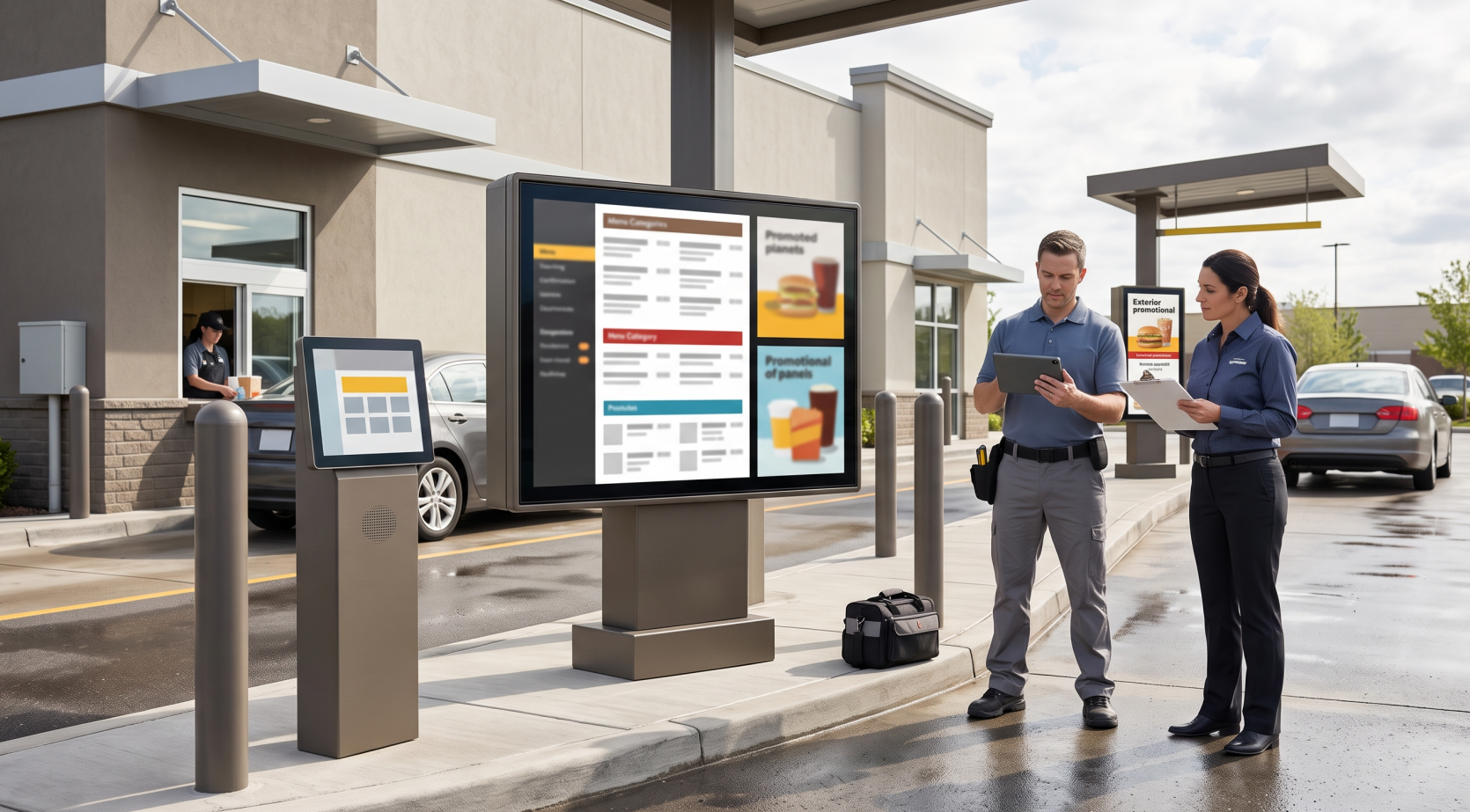
In a recent study, the National Restaurant Association found that drive-thru purchases accounted for 43% of all QSR revenue. In today's market, QSR outdoor digital signage is one of the clearest ways to capitalize on it. This particular selection of tech refers to more than just drive-thru menu boards, however, as it also includes order confirmation screens and other exterior digital displays for menu items, pricing, and promotions.
Unfortunately, the elements don't care how vital these installations are to your business. Unlike an indoor digital menu board mounted behind the counter, an outdoor digital menu board has to survive direct sunlight, rain, temperature swings, and the occasional bump from a delivery truck, all while staying legible enough to keep the drive-thru lane moving.
This guide is written for QSR operators, franchisees, and restaurant IT teams evaluating an upgrade from static menu boards or an outdoor display that's started to show its age. We'll provide the rundown on:
- The exact system differentiations between indoor and outdoor systems
- How to tell if you're close to needing an update
- How to make sure your installation won't leave anything to be desired
Outdoor vs. Indoor Digital Signage: 7 Extra Requirements for Long-Lasting Outdoor Performance
An indoor digital menu board only has to compete with restaurant lighting, foot traffic, and maybe the occasional child touching the screen, but an outdoor digital menu board faces a much tougher job.
More temperate locations with only slight temperature dips across the year will be less dependent on weatherproofing, but an installation in Arizona will need to stand up to triple-digit temperatures while an installation in Minnesota might need to stay functional in negative double digits. This is why the specifications that make a screen good enough indoors fall short the moment it moves outside.
|
Requirement |
Indoor Digital Signage |
Outdoor Digital Signage |
|
Brightness |
300–500 nits, standard commercial-grade |
2,500–4,000+ nits, high-bright or sunlight-readable panel |
|
Weatherproofing |
Not required |
NEMA 4 / IP65-rated enclosure against rain, dust & moisture |
|
Operating Temperature Range |
Climate-controlled, ~50–95°F |
Engineered for temperature extremes, often -20°F to 122°F+ |
|
Housing & Enclosure |
Open-frame or wall-mounted |
Sealed, weatherproof, often steel or reinforced polymer |
|
Power & Surge Protection |
Standard building electrical |
Dedicated surge protection & outdoor-rated electrical runs |
|
Anti-Glare & Discoloration |
Minimal glare concerns |
Anti-reflective coating & anti-discoloration technology required |
|
Vandalism & Impact Resistance |
Rarely a factor |
Shatterproof screens & lockable, tamper-resistant housings |
By keeping these requirements on lockdown, you'll save time and money on repairs and keep your warranty active for as long as possible. Skipping the enclosure rating or the surge protection alone is often enough to surface as a costly repair call within the first year or two.
6 Warning Signs Your Outdoor Menu Board Is Limping Along
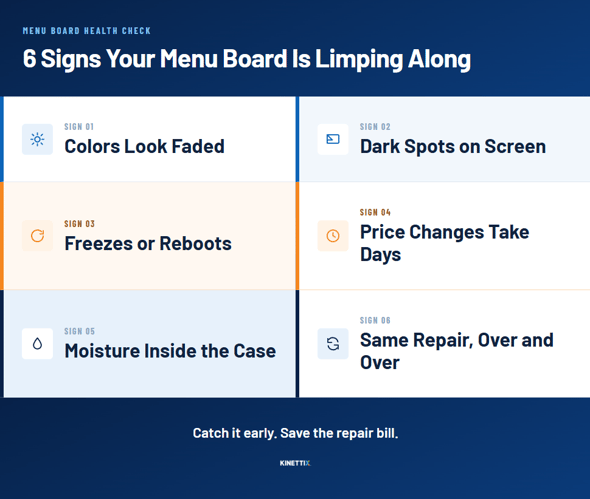
Menu board deterioration trickles in slowly rather than manifesting in a catastrophic breakdown. The signs are subtle and can be missed, but if you know what to look for, they can be caught and dealt with for cheap in order to avoid large, costly, time-consuming repairs:
- Faded or Washed-Out Screen Colors
Sun exposure gradually breaks down the color accuracy of an outdoor digital menu board, leaving menu items looking dull or washed out compared to when the display was new. Once fading starts, brand colors and food photography lose the visual punch that drives impulse orders.
- Uneven Brightness or Dark Spots
Dark patches or uneven brightness across the screen usually point to a failing backlight or panel damage from heat and moisture. Left unaddressed, these dead zones only spread, eventually taking chunks of the menu out of view entirely.
- Frequent Freezing or Rebooting
A digital menu board that freezes mid-transition or reboots itself during peak hours is often struggling with heat buildup inside the enclosure. This kind of instability slows down order-taking exactly when the drive-thru lane needs to move fastest.
- Menu Changes That Take Days Instead of Minutes
Digital signage is supposed to make menu updates instant, so a board that takes days to reflect a new price or limited-time offer has likely lost its remote connection. That delay quietly pushes a QSR back toward the same slow, manual process digital was meant to replace.
- Visible Condensation or Moisture Inside the Housing
Fog or water droplets inside the housing are a clear sign the enclosure seal has failed, letting outside moisture reach sensitive electronics. Left alone, this kind of exposure typically leads to corrosion and a much larger repair bill down the road.
- Rising Repair Calls for the Same Recurring Issue
When the same component keeps failing every few months despite repeated repairs, the underlying hardware has likely reached the end of its useful life. At that point, continued repairs usually cost more over a year than simply replacing the unit.
7 Digital Signage Upgrades That Turn Idle Drive-Thru Time Into Sales
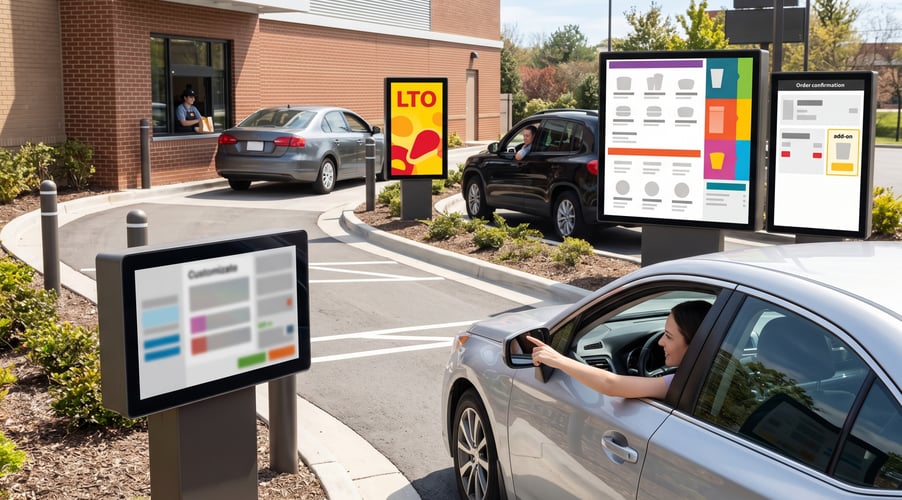
Ordering at a drive-thru and receiving your food are the best parts of the process for any customer, but waiting in line can get dull time after time. Additional informational panels give customers something to look at instead of idling in the drive-thru lane. That engagement turns dead time into an opportunity to drive extra sales and speed up the overall transaction.
- Daypart Menu Scheduling That Switches Automatically
Daypart scheduling automatically swaps a breakfast menu for the lunch or all-day menu at a preset time, no manual intervention required. This keeps the digital menu board relevant to what's actually being served and removes the clutter of showing every item all day long.
- Order-Triggered Upselling Prompts
As a customer's order is entered into the POS system, the digital menu board can surface a relevant add-on or combo suggestion in real time. This kind of automatic upselling tends to lift average ticket size without adding a single extra step for staff.
- Limited-Time Offer Promotion in Real Time
Digital signage lets a QSR launch a limited-time offer the same day it's approved, rather than waiting weeks for new printed panels to arrive. That speed makes it easier to react to slow dayparts, local events, or a competitor's new promotion.
- Wait-Time Content That Keeps Customers Engaged
During longer wait times, digital displays can rotate in branded content, entertainment, or highlighted menu items instead of leaving the same static screen up. Keeping attention on the display tends to reduce how long the wait actually feels to the customer.
- Centralized, Remote Content Updates Across Every Location
A centralized content management system lets a corporate team push a price change or new promotion to every location at once, instead of relying on individual franchises to update their own signage. That consistency matters for fast-food brands trying to keep pricing and messaging aligned nationwide.
- High-Brightness Displays That Stay Readable in Direct Sunlight
A high-brightness outdoor display stays legible even when the sun is hitting the screen directly, which a standard commercial panel simply can't do. Customers who can actually read the menu without squinting tend to make decisions faster, keeping the drive-thru lane moving.
- Touch-Enabled Ordering Integration at the Drive-Thru Lane
Touch-enabled outdoor displays let customers browse and customize their order directly at the drive-thru lane, cutting down on the back-and-forth with a speaker box. This kind of self-service option also gives QSRs another data point on what customers actually want to order.
Your Drive-Thru Deserves Better Than a Flickering Screen: Talk to Kinettix
A flickering, faded, or unreliable outdoor menu board costs more in lost sales than most QSR operators realize. Every minute a display sits broken or illegible is a minute of drive-thru engagement that drives right on by.
Kinettix is a field services provider, backed by certified technicians and a standardized process, that installs and maintains outdoor digital signage for QSR brands nationwide. Reach out now to talk through what your current setup needs before the next display failure catches you off guard.
5 Installation Standards That Keep Every Outdoor Enclosure Weatherproof and Warrantied
Outdoor menu installations are only durable if they're subjected to regular upkeep and maintenance to ward off any consistent wear and degradation. Cut corners during installation shorten a sign's lifespan and create new points of failure..
These five installation standards are what Kinettix follows on every outdoor digital signage project, from a single restaurant to a full multi-site rollout.
|
Installation Standard |
Benefit It Delivers |
|
Pre-Visit Site Readiness Validation |
Confirms power, mounting surface & connectivity before equipment ships, preventing install-day surprises |
|
Sealed, Rated Enclosure Mounting |
Locks in NEMA/IP-rated protection against rain, dust & moisture from day one |
|
Licensed Electrician Coordination for Structural Work |
Ensures foundation, conduit & electrical work meets code and manufacturer specs |
|
Surge Protection & Grounding at Every Site |
Shields the display from power spikes common in outdoor drive-thru electrical runs |
|
Documented Closeout & Warranty Registration |
Protects manufacturer warranty coverage and gives the brand an auditable install record |
Case Study: Keeping 1 QSR Chain's Drive-Thru Boards Running Coast to Coast)
A digital merchandising solutions provider with offices spanning six countries relied on Kinettix to install & repair drive-thru menu boards on behalf of its direct client, a global fast food chain. Unlike a single cut-and-dried rollout endeavor, this partnership continues to run on an ongoing basis with Kinettix on call to provide any support that the client may need. Kinettix always needs to be ready to provide on-site tech support in the event of a malfunction without relying on routine maintenance checks and scheduled appointments.
At a Glance
- Client: Digital merchandising solutions provider (six global offices)
- End Customer: Global fast food chain
- Service Type: Ongoing install & repair of drive-thru menu boards
- Coordination Platform: Dispatch1®, later integrated with the client's Salesforce instance
- Delivery Model: Unplanned, on-demand dispatch nationwide
|
Challenge |
Approach |
Outcome |
|
Downtime at restaurant locations from a previous vendor's slower response times, without the specialized technical expertise each unplanned dispatch demanded |
Kinettix routes every request through Dispatch1®, pairing an IT field technician with a licensed electrician on each visit, vetting & briefing both before they're sent, tracking equipment & replacement parts, and monitoring weather to keep schedules realistic |
Dispatch volume grew from 5-6 requests a week to more than 20, with high completion rates & minimal downtime at restaurant locations |
By the Numbers: 5-6 → 20+ weekly dispatches
This became Kinettix's largest dispatch engagement to date, a scale made possible by pairing Dispatch1® with the client's own Salesforce instance for streamlined request tracking.
The same dispatch protocol that handles a same-day repair scales just as easily to a full replacement, keeping the response consistent no matter what a board needs.
7 Questions Your QSR Brand Should Ask About Outdoor Digital Signage Before Installation
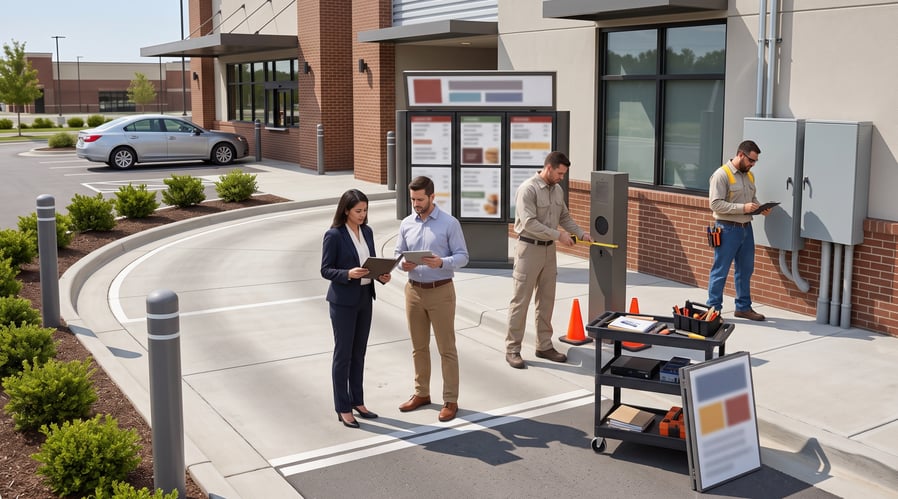
Constructing and installing stronger outdoor digital signage is a complicated undertaking that requires no small amount of preparation and oversight. We've assisted several such campaigns in the past and have heard all the questions you can imagine. Here's the questions we get most frequently, in case you're wondering the same thing:
- How Much Does Outdoor Digital Signage Installation Typically Cost?
Costs vary based on screen size, enclosure rating, number of locations, and whether electrical or structural work is needed at each site. A multi-location QSR should request a scoped estimate rather than relying on a rough industry average, since site conditions differ so much from one location to the next.
- What Kind of ROI Can a QSR Expect From Upgrading to Digital?
Returns typically show up through faster order-taking, higher average ticket size from automated upselling, and lower long-term costs compared to reprinting static menu panels every time a price changes. The exact payback period depends on transaction volume, but many QSRs see the upgrade pay for itself within the first year or two of drive-thru traffic.
- How Long Does a Single-Site Installation Take Start to Finish?
A straightforward digital menu board swap can often be completed within a day, while a full outdoor enclosure installation involving new electrical or structural work usually takes several days. Multi-site rollouts add coordination time but don't necessarily extend the on-site work at each individual location.
- Can Outdoor Digital Signage Integrate With Our Existing POS System?
Most modern digital signage platforms are built to connect with leading POS systems through an API, allowing pricing and item availability to sync automatically. It's worth confirming compatibility with your specific POS provider early in the planning process, since older or highly customized systems sometimes need additional configuration.
- What Should Be Included in an Outdoor Signage Maintenance Contract?
A solid maintenance agreement should spell out visit frequency, response times for emergency repairs, what's covered versus billed separately, and how quickly a technician can reach the site if a board goes down. Getting these terms in writing upfront avoids confusion later about what a QSR is actually paying for.
- What Happens If a Board Goes Down During Peak Drive-Thru Hours?
Most QSRs fall back on a printed backup menu or staff taking orders manually at the window until a technician arrives, which slows service but keeps the lane moving. A field service partner with a fast response time can typically get a technician on-site within hours rather than days, limiting how long that manual workaround has to last.
- Do We Need a Licensed Electrician, or Can Field Techs Handle Everything?
Straightforward tasks like mounting a display or swapping a media player can usually be handled by a certified field technician alone. Anything involving new electrical circuits, conduit, or a poured foundation for a freestanding enclosure typically requires a licensed electrician working alongside the installation team.
Your Digital Menu Board Shouldn't Fear the Forecast: Let's Build It Right
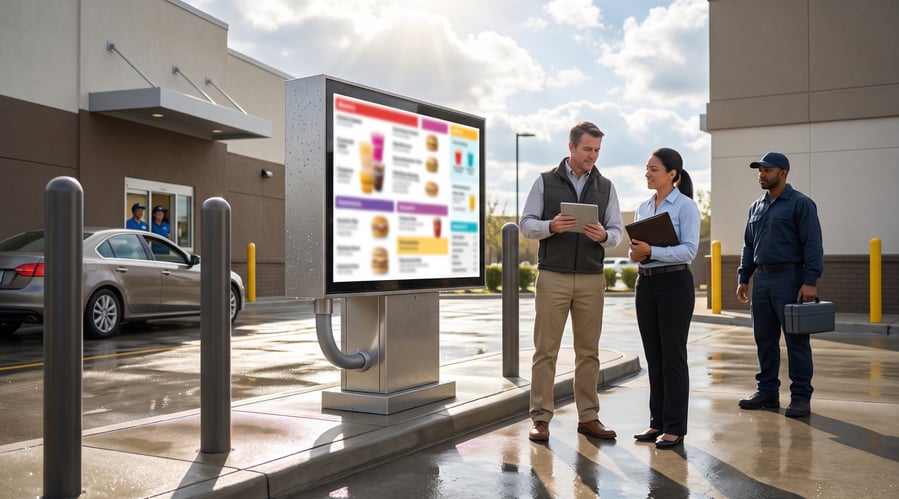
If direct sunlight, a hard rain, or a hot summer afternoon is enough to take down your outdoor digital menu board, then it was never fit for the job to begin with. Every requirement covered in this guide, from brightness and weatherproofing to a properly grounded enclosure, exists because any breach in your system's integrity is enough for degradation to start trickling in and picking apart your signs over time. Getting it right the first time costs less than repairing or replacing a board that wasn't built for the job in the first place.
Kinettix installs and maintains outdoor digital signage for QSR brands with a handful of locations and national chains with thousands. From the initial site survey through electrical coordination, enclosure mounting, and documented closeout, Kinettix handles every step of the process with certified technicians and project management so a warranty claim never turns into a dispute.
Contact us to talk through what your current outdoor signage setup needs and what a properly built digital menu board actually looks like for your restaurants.