
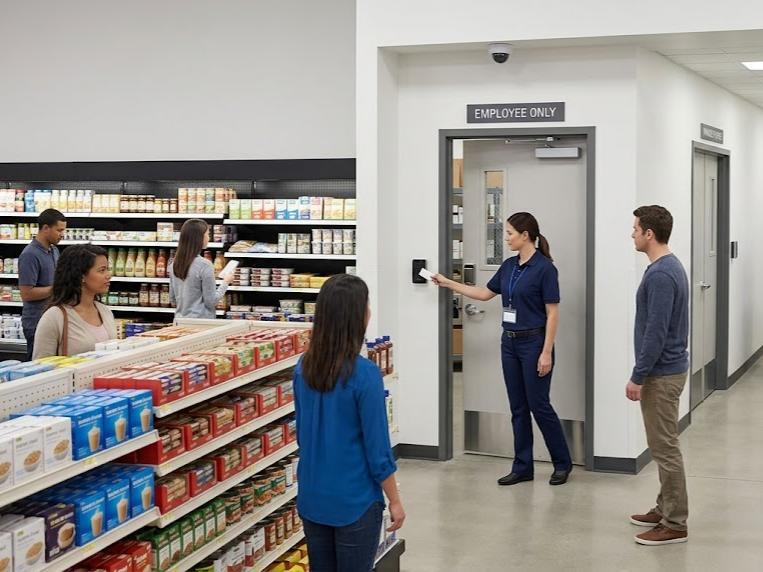
NRF research shows that retail shrinkage costs U.S. businesses tens of billions of dollars every year, and a significant portion of those losses trace directly back to access control failures that nobody addressed until after an incident occurred such as:
- Stockroom doors propped open
- Credentials never revoked after turnover
- Vendor badges that float between shifts
- Back-of-house zones that anyone in a uniform can enter
These examples represent the operational baseline at thousands of retail locations running security infrastructure that was never designed for the scale, complexity, or threat landscape of modern enterprise retail.
Verkada's access control platform gives multi-location retailers the credential management, audit trail depth, and cloud-based visibility to close those gaps across every store in their portfolio from a single dashboard. Kinettix deploys certified technicians across all 50 U.S. states and 90+ countries to execute those installations with the standardized protocols and centralized coordination that enterprise retail access control deployments demand.
Every location we touch is assessed, installed, tested, and documented to the same standard, so your access control system performs the way it was designed to, from location one to location one hundred.
8 Ways Inadequate Access Control Quietly Bleeds Your Retail Operation Dry
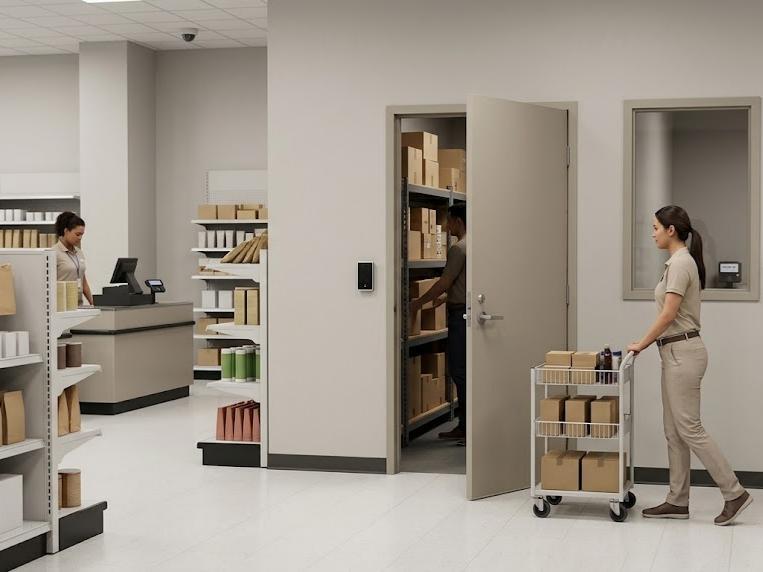
Retail security failures rarely announce themselves. Losses accumulate through access gaps that compound quietly across every store until shrinkage figures, liability exposure, or a high-profile incident forces a reckoning with infrastructure that should have been addressed years earlier.
-
Unchecked Internal Theft in Restricted Areas
Employee theft concentrates in the areas of the store where access is least monitored. Stockrooms, cash rooms, and receiving areas without credential-controlled entry become high-risk environments the moment staff recognize nobody is tracking who goes in or when.
- Organized Retail Crime Groups Exploiting Predictable Access Patterns
According to the NRF's 2025 Impact of Retail Theft & Violence report, 66% of retailers reported transnational ORC involvement in thefts against their companies, with criminal groups expanding their tactics across physical and digital channels simultaneously. ORC groups surveil target locations before acting, and propped doors, shared credentials, and unmonitored back entrances give them exactly the intelligence they need.
- Vendor and Contractor Access That Nobody Is Actually Tracking
Third-party badges that get shared, reused after contract expiration, or never formally deactivated create persistent access vulnerabilities that sit completely outside the visibility of most retail security systems.
- After-Hours Intrusions With No Documented Entry Trail
Without credential-controlled access points and time-based lock schedules, a store after closing is as accessible as during business hours to anyone who knows where the gaps are. No entry trail means no evidence for investigations or insurance claims.
- Cash Room and Safe Exposure From Shared or Unrevoked Credentials
Shared access codes circulating among shift supervisors or key cards never deactivated after departure transform a secured cash room into a space that is only theoretically restricted.
- POS Zone Vulnerability Creating Transaction Fraud Opportunities
According to Appriss Retail vice president Cheryl Blake, internal theft in omnichannel retail environments now spans multiple touchpoints, specifically including the point-of-sale, return desk, receiving dock, warehouse, and distribution channels. Unrestricted access to POS terminals and connected back-office systems removes the accountability layer that loss prevention needs to correlate access events with transaction anomalies during fraud investigations.
- Liability Claims With No Access Log to Dispute Them
Slip-and-fall claims, workplace incident disputes, and fraudulent return allegations all hinge on who was present in a specific area at a specific time. Legacy key-based infrastructure provides no documented record to draw on when accountability is demanded.
- Multi-Site Security Gaps That Compound Every Time a New Location Opens
A retail chain's security posture is only as strong as its least-protected location. Every new store that opens without a standardized access control deployment silently extends the attack surface of the entire portfolio.
5 Access Control Technologies Reshaping How Retailers Secure Their Stores
The retail access control market has moved well beyond the metal key, and the technology options available to enterprise retailers today range from basic electronic credential systems to fully cloud-managed platforms capable of governing thousands of access points across hundreds of locations from a single interface.
Selecting the right technology for each zone and use case in your store portfolio requires understanding what each system actually delivers, not just what it costs to install.
|
Technology |
Impact |
|
Key Card & Fob Systems |
Programmable credentials that replace physical keys with issuable, modifiable, and deactivable access rights. Supports tiered permissions and basic audit trails across store zones. |
|
Mobile Credential Access |
Smartphone-based authentication via Bluetooth or NFC. Enables instant remote credential issuance and revocation, ideal for high-turnover retail environments and distributed management teams. |
|
Biometric Authentication |
Identity verification through fingerprints, facial recognition, or iris scans. Non-transferable credentials best suited for cash rooms, server closets, and other high-accountability restricted zones. |
|
Cloud-Managed Unified Access Control |
Centralizes credential management, access logging, and system configuration across unlimited locations in one dashboard. Real-time portfolio-wide visibility with no on-site IT required. |
|
PIN & Keypad Entry |
Low-cost credential control for lower-risk areas. PINs can be shared or observed, making them unsuitable for high-security zones without a secondary authentication layer. |
Each of these technologies serves a distinct security function, and the most effective retail access control deployments do not pick one and apply it uniformly across every door.
6 Steps Every Retailer Should Take Before Installing a Single Door Reader

Skip the planning phase and you'll end up with door readers in the wrong locations, credential structures that don't reflect real operations, and a system that needs expensive rework six months after go-live.
- Conduct a Zone-by-Zone Security Risk Assessment
- Rate every store zone by risk level: high, medium, or low
- Document which high and medium-risk zones currently have no credential control
- Flag existing access systems creating gaps or inconsistencies across locations
- Map Every Access Point That Requires Credential Control
- Document every door, gate, elevator, service entrance, and loading dock at each store
- Note any unusual frame conditions or space constraints affecting hardware selection
- Produce a per-store access point count to inform procurement scope
- Define Role-Based Permission Levels for Every Staff Category
- Map each staff category to the specific zones their role requires
- Define time-based access restrictions where applicable
- Get sign-off from HR, loss prevention, and operations before any credential programming begins
- Audit Existing Infrastructure for Network and Power Readiness
- Confirm available PoE switch ports at each planned reader location
- Verify network switches support the power draw requirements for door controllers
- Flag locations requiring new cabling runs before installation is scheduled
- Select a Scalable Platform That Supports Your Full Store Count
- Confirm single-dashboard management across unlimited locations without per-site licensing
- Verify offline credential validation so doors function normally during internet outages
- Confirm integration compatibility with existing cameras, alarms, and visitor management tools
- Choose a Certified Installation Partner With Multi-Site Experience
- Verify active Verkada Technical Certifications
- Request evidence of previous multi-site retail deployments
- Confirm standardized work packages, uniform closeout documentation, and break-fix coverage across every geography where you operate
- Establish a Credential Lifecycle Management Protocol Before Go-Live
- Document credential issuance, role-change, and offboarding processes before launch
- Assign a named owner for credential lifecycle management at the program level
- Schedule a 90-day post-launch credential audit to catch orphaned or misconfigured access rights
Stop Guessing Which Stores Are Exposed: Talk to a Kinettix Deployment Specialist Today
Every day a retail location operates without properly deployed access control is a day that stockrooms, cash rooms, and restricted zones are accessible to anyone who has learned where the gaps are. Kinettix brings the vetted technician network, certified deployment expertise, and standardized installation protocols to close those gaps across every store in your portfolio with the consistency that enterprise retail security demands.
Reach out now to connect with a Kinettix coordinator and get your retail access control deployment scoped, staffed, and scheduled with a team that has executed this work across distributed retail footprints at scale.
Verkada Access Control: 1 Platform, Every Location, 0 Infrastructure Headaches

Verkada's access control system runs on the same cloud-managed architecture as its cameras, alarms, intercoms, and environmental sensors, meaning every access event, credential alert, door status, and remote unlock action is visible from a single browser interface: Verkada Command. No on-site server, no per-location software license, no VPN required.
Door readers ship pre-configured and connect to the Verkada organization the moment they power on. From Command, administrators can issue mobile credentials, configure time-based schedules, set lockdown triggers, and pull audit logs for any door at any location in real time from anywhere. For enterprise retailers managing access control across dozens or hundreds of stores, that combination of operational simplicity and portfolio-wide visibility is why Verkada has become the platform of choice for multi-site retail access control deployments.
Verkada is strongest for multi-site retailers that need centralized cloud management, rapid deployment at scale, and a unified platform across security systems. Retailers with strict on-premise data residency requirements, existing access control hardware they are contractually locked into, or highly customized local integrations may need a compatibility review before standardizing on Verkada, and Kinettix can help scope that evaluation before any hardware is committed.
What Professional Retail Access Control Installation Actually Looks Like at Enterprise Scale
Deploying access control across one store is straightforward. Deploying it consistently across fifty, one hundred, or three hundred locations without gaps, configuration errors, or infrastructure failures at any single site is a different challenge entirely, and the outcome depends almost entirely on the installation partner executing the work.
- Pre-Installation Site Survey and Infrastructure Assessment
Structured onsite assessment of door frame conditions, network connectivity, PoE switch capacity, cabling pathways, and mounting surface viability before any equipment is committed to a location.
- System Design and Access Zone Mapping
Every door reader, request-to-exit device, and electronic lock strike is mapped against the store's specific zone requirements and credential hierarchy, ensuring hardware placement reflects actual security needs, not a generic template.
- Network Readiness Validation
Kinettix technicians verify network connectivity and VLAN configuration at every site before installation begins, catching connectivity gaps before hardware is mounted rather than after.
- Standardized Hardware Mounting and Cabling
Consistent mounting methods, clean cable management, and clear device labeling applied at every location regardless of which technician executes the work, making every site auditable, maintainable, and expandable.
- Platform Configuration and Credential Setup
Every Verkada device is configured to the retailer's credential hierarchy, time-based schedules, alert thresholds, and integration settings against a documented standard that produces identical baseline settings across every location.
- Integration Testing Across All Connected Systems
Every integration point, cameras, alarms, intercoms, and Verkada Command, is tested and validated before site closeout. Failures are resolved before handoff, not after stores go live.
- Staff Orientation and Handoff Documentation
Store managers and loss prevention personnel receive hands-on orientation before the installation team departs, along with comprehensive documentation covering device locations, configuration records, zone maps, and support contacts.
- Post-Installation Support and Break-Fix Coverage
Kinettix maintains an on-demand break-fix dispatch network across every geography in the deployment footprint, ensuring access control issues are resolved before stores operate with compromised security.
Case Study: How Kinettix Deployed Retail Access Control Across Every Location Without Compromising a Single Site

A multi-site industrial operator needed to modernize its physical security footprint without disrupting active facility operations. The challenge wasn't just deploying Verkada hardware, it was building a scalable, repeatable model that produced consistent installation quality and uniform documentation across every location, without restarting the planning process at each new site.
Kinettix's Solution
Kinettix built a structured field services model around repeatable work packages and centralized program oversight rather than treating each site as an independent engagement.
- Standard Work Packages & Repeatable Deployment Workflows
Every site followed the same five-phase sequence, pre-visit planning, readiness validation, standardized installation, functional testing, and closeout documentation, ensuring no location received a lower standard of execution regardless of on-site conditions.
- Centralized Coordination to Reduce Site-to-Site Variability
Centralized scheduling, stakeholder alignment, and shared expectations kept every location operating from the same plan, preventing the interpretation drift that fractures multi-site deployments.
- Exception-Driven Reporting for Structured Deviation Management
Network shortfalls, inaccessible mounting surfaces, and cabling limitations were captured in structured documentation and routed through a defined resolution process, treated as managed variables, not silent inconsistencies.
Execution
Kinettix carried out the deployment through five structured phases applied uniformly across every location, removing the execution variability that typically undermines quality and schedule reliability in distributed access control rollouts.
- Pre-Visit Alignment & Access Coordination
Site access plans, escort requirements, and logistics confirmed before each visit so technicians began productive work on arrival.
- Onsite Readiness Checks Using the Same Checklist at Every Site
Structured verification of network connectivity, PoE switch capacity, mounting surfaces, and cable routing before any installation work began.
- Standardized Verkada Device Installation & Cable Management
Verkada-certified project managers installed all devices using consistent mounting methods, clean cable routing, and clear labeling, no on-the-ground judgment calls varying between technicians.
- Functional Verification & Baseline Operational Testing
Every device tested for power, connectivity, and baseline performance before site sign-off, eliminating post-installation revisits from preventable setup failures.
- Uniform Closeout Documentation & Program Handoff
Standardized closeout packages capturing completed work, validation outcomes, and exceptions gave leadership a consistent record set across every location.
End Results
By managing the engagement as a scalable deployment program rather than a collection of individual site visits, Kinettix produced outcomes that went well beyond access control hardware installation.
- A Repeatable Deployment Blueprint Built to Scale
Every site followed the same lifecycle from readiness through handoff, a documented framework that carries forward to future locations without rebuilding the process each time.
- More Predictable Installation Quality Across All Facilities
Consistent methods and defined acceptance criteria reduced workmanship variability and post-installation troubleshooting across the portfolio.
- Fewer Surprises Through Standardized Readiness Validation
Early infrastructure checks surfaced constraints as documented exceptions rather than mid-deployment discoveries forcing costly adjustments.
- Stronger Documentation for Audits & Future Expansion
Standardized closeout records support ongoing maintenance, compliance reviews, and confident expansion planning across the full portfolio.
Verkada Tech Stack: How Access Control Connects to Your Full Retail Security System
Verkada access control's real advantage isn't the standalone system, it's how every component integrates into a unified security ecosystem that shares data, triggers coordinated responses, and feeds into a single management interface.
|
Tech Synergy |
Security Benefit |
|
Access events automatically pull corresponding door footage, turning every access log entry into a reviewable visual record. Investigation timelines compress from hours to minutes. |
|
|
Forced doors, held-open thresholds, and after-hours access automatically trigger alarm responses, all managed from the same Command dashboard as access control. |
|
|
Temperature, humidity, air quality, and vaping activity monitored in camera-restricted zones. When a sensor alert fires, the access log immediately identifies who was in that area. |
|
|
Remote visual verification before access is granted at loading docks, employee entrances, and after-hours entry points, no staff member required on-site at the door. |
|
|
AI-Powered Video Analytics |
Edge-based AI detects tailgating at access-controlled doors, flagging unauthorized individuals who follow credentialed employees through secured entries without presenting credentials. |
|
Guest & Visitor Management |
Time-limited credentials issued to contractors and vendors that expire automatically after the approved access window, eliminating the unrevoked third-party credential problem entirely. |
|
Verkada Command Unified Dashboard |
Every access event, camera feed, alarm, sensor trigger, intercom interaction, and visitor credential across every location managed from one interface, no platform switching required. |
6 Retail Access Control Questions That Deserve a Straight Answer Before You Deploy

Retailers evaluating access control deployments ask a consistent set of practical questions that go beyond what vendor documentation typically covers in useful depth. The answers below address the operational and logistical specifics that determine whether a multi-site retail access control rollout is planned correctly from the start.
-
How long does access control installation take per retail location?
Timelines vary based on access point count, door frame conditions, network readiness, and site-specific restrictions. Most standard installations covering primary entries, stockroom doors, and cash room access complete within one to two days per site, with complex deployments scoped accurately during Kinettix's pre-installation assessment.
- Can access control credentials be managed remotely across all stores from one dashboard?
Verkada Command delivers full remote credential management across unlimited locations from a single browser interface, no on-site IT required. Administrators can issue credentials, modify permissions, configure schedules, and pull audit logs for any door at any store from anywhere.
- What happens to access control functionality when the internet goes down at a store?
Verkada door controllers store credentials and permission rules locally, so employees continue badging in and out normally during an outage. Once connectivity restores, the controller syncs event logs and configuration updates to the Verkada cloud automatically.
- How do you handle credential revocation when an employee leaves across a large store network?
A single action in Verkada Command deactivates credentials instantly across every location simultaneously, no per-store coordination required. For high-turnover retail operations, this centralized revocation capability eliminates the exposure window between an employee's departure and credential deactivation.
- What is the difference between cloud-managed and on-premise access control for retail?
Cloud-managed systems store credentials and logs in the vendor's cloud, delivering management through a browser accessible from anywhere. On-premise systems store everything on local servers requiring physical maintenance and on-site access to administer. For multi-site retailers, the practical gap is significant: cloud scales across new locations without new server hardware, supports remote administration portfolio-wide, and updates automatically, while on-premise compounds in infrastructure cost and management complexity with every new store.
- How do you ensure installation quality stays consistent when deploying across hundreds of locations?
Kinettix applies the same five-phase deployment sequence, pre-visit planning, infrastructure validation, standardized installation, functional testing, and closeout documentation, at every location regardless of which technician executes the work. Exception-driven reporting ensures site-specific variables are managed as documented deviations rather than ad hoc judgment calls that produce inconsistent outcomes.
- What Compliance/HR considerations do I need to plan for?
Biometric credential systems trigger state-level biometric privacy laws in Illinois, Texas, Washington, and others, requiring written consent policies and defined data retention limits before deployment. On the HR side, access control systems that log employee movement can intersect with labor relations obligations, particularly in unionized environments where monitoring scope may require disclosure or negotiation. Engage legal and HR leadership in the permission matrix sign-off process before go-live, not after.
Your Stores Are Only as Secure as the Weakest Door in Your Portfolio: Change That Today

Kinettix deploys Verkada retail access control systems across distributed retail footprints with the vetted technician network, certified deployment expertise, and standardized installation protocols that enterprise security programs require. Every uncontrolled access point, every unrevoked credential, and every store that opened without a standardized access control deployment is a gap in your portfolio's security posture that compounds in risk with every passing day it goes unaddressed.
Contact us today to connect with a Kinettix coordinator and get your retail access control deployment scoped, staffed, and scheduled with a team that has done this work at scale.