
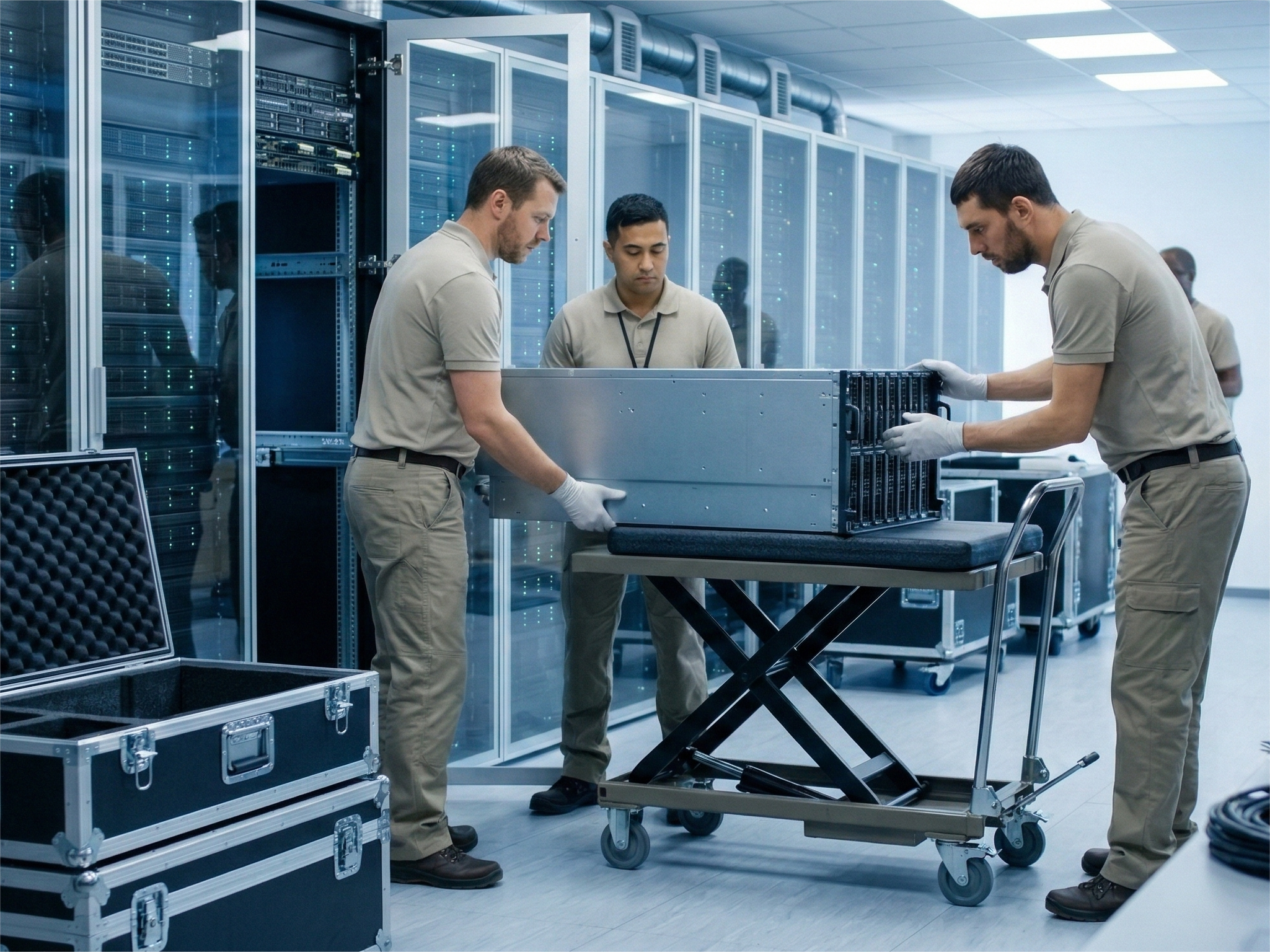
Data center relocation is one of the most logistically demanding projects an IT organization can take on. Critical systems, sensitive hardware, and live business operations all hang in the balance the moment equipment starts moving.
Kinettix brings the global field resources, proven methodologies, and dedicated project management muscle to execute your data center relocation project from first assessment to final go-live, with minimal downtime and zero surprises. Our experienced team has managed complex IT infrastructure moves across industries, and we treat every relocation with the same level of precision and accountability regardless of scope.
What Are The 7 Most Common Data Center Relocation Pitfalls?
Most data center relocations don't fail because of bad luck. They fail because of preventable planning gaps that compound into expensive, disruptive problems. Understanding the most common pitfalls before your project begins is the single most effective way to protect your business operations and ensure a seamless transition.
- Underestimating Interdependency Mapping
Before a single server is powered down, every application, system, and network connection needs to be mapped against the equipment it depends on. Teams that skip this step routinely discover mid-move that taking one system offline cascades into unexpected outages across critical infrastructure.
- Inadequate Asset Inventory Before the Move
A complete, verified asset inventory list is the foundation of any successful data center relocation process. Without it, equipment gets lost in transit, documentation falls apart, and post-move validation becomes a guessing game that drags timelines out well past the original deadline.
- Ignoring Infrastructure Compatibility at the New Location
The new facility needs to support your existing IT infrastructure before the first rack arrives, not after. Power capacity, cooling systems, rack spacing, and network connectivity all need to be verified during site surveys to avoid discovering incompatibilities on move day.
- Poor Chain-of-Custody Protocols During Transport
Every IT asset in transit needs to be tracked, documented, and secured under strict chain-of-custody protocols from the moment it leaves the old facility. Teams that treat transport as a logistics afterthought create serious exposure to equipment damage, asset loss, and data security gaps that can trigger regulatory compliance issues.
- Insufficient Post-Move Validation Planning
Getting equipment to the new location is only half the job. Systems need to be tested, configurations verified, and applications confirmed operational before the relocation project can be considered complete, and that validation process needs to be planned long before move day arrives.
- Overlooking Regulatory & Compliance Requirements
Industries like healthcare, finance, and government operate under strict data security and handling regulations that don't pause for a relocation project. Failing to account for HIPAA, PCI DSS, SOC 2, and other applicable industry regulations during the move can create compliance gaps that are far more costly than the relocation itself.
- Failure to Account for Equipment Damage Risks in Transit
Server equipment, networking equipment, and storage hardware are precision instruments that are highly vulnerable to vibration, temperature fluctuation, and physical shock during transport. Without climate-controlled vehicles, proper anti-static packaging, and purpose-built crating, even a short move across town can result in hardware failures that set your go-live date back by weeks.
9 Essential Steps that Ensure a Seamless Data Center Relocation
A seamless data center relocation doesn't happen by accident. It follows a structured, repeatable process that accounts for every risk, dependency, and technical requirement before any equipment is touched. Each step below builds on the last, creating a clear path from initial assessment to full operational status at the new location.
|
Relocation Step |
Process Impact |
|
Pre-Move Site Survey & Assessment |
Technicians conduct a thorough evaluation of both the current and destination facilities, verifying power capacity, cooling infrastructure, rack compatibility, and network connectivity to identify and resolve potential issues before the move begins. |
|
Detailed Asset Inventory & Tagging |
Every server, networking device, storage unit, and piece of specialized equipment is catalogued, tagged, and documented to create a complete asset inventory that supports tracking, accountability, and post-move validation throughout the project. |
|
Dependency Mapping & Risk Analysis |
All application dependencies, system interconnections, and critical infrastructure relationships are mapped to identify which systems must be migrated in sequence and where the highest risk factors exist within the relocation project plan. |
|
Infrastructure Freeze & Move Documentation |
A freeze period is established to lock configurations and prevent unauthorized changes to IT assets ahead of the move, while full move documentation is prepared to ensure every technician has clear, accurate instructions for deinstallation and reinstallation. |
|
Secure De-Installation & Equipment Packing |
Experienced technicians carefully power down and deinstall all equipment according to manufacturer specifications, using anti-static wrapping, shock-absorbing materials, and tamper-proof packaging to protect sensitive hardware throughout the packing process. |
|
Climate-Controlled, Bonded Transport |
All IT assets are loaded into climate-controlled, GPS-tracked vehicles operated under bonded transport protocols, maintaining the temperature and humidity thresholds required to protect server equipment and networking hardware from environmental damage in transit. |
|
Re-Racking, Cabling & Physical Setup |
At the new facility, equipment is installed according to the approved rack layout, with structured cabling, cable management, and power distribution completed to manufacturer specifications and industry best practices before any systems are powered on. |
|
Systems Testing & Post-Move Validation |
Every system is powered on and tested against pre-established benchmarks to confirm full functionality, with applications verified, network connectivity confirmed, and any post-move issues identified and resolved before the facility is handed back to operations. |
|
Go-Live Confirmation & Post-Move Support |
Once all systems pass validation, the data center is officially brought back online with a formal go-live confirmation, and the Kinettix team remains available for post-move support to address any issues that emerge during the initial period of resumed operations. |
6 Qualities That Separate Great Data Center Relocation Specialists from the Rest

Selecting the right data center relocation partner is one of the most consequential decisions in the entire project. The difference between a smooth transition and a costly disaster often comes down to who is managing the move, not just how the move is planned.
- Proven Track Record Across Complex Migrations
A data center relocation specialist worth trusting should be able to point to a documented history of completed projects across diverse environments, industries, and scales. Extensive experience isn't a nice-to-have on a project where critical systems and sensitive information are at stake, it's the baseline standard.
- Dedicated Project Manager per Relocation
Every data center relocation project deserves a single, accountable project manager who owns the timeline, the communication, and the outcomes from day one. Without a dedicated project manager, coordination gaps compound quickly and clients are left chasing updates instead of running their business.
- Comprehensive Asset Inventory Management
The best relocation specialists build and maintain a detailed inventory list that tracks every IT asset through every phase of the move, from deinstallation through reinstallation. Rigorous asset tracking is what separates partners who can guarantee accountability from those who can only offer best-effort logistics.
- Strict Chain-of-Custody & Security Protocols
Data security during a physical relocation requires documented chain-of-custody procedures that govern who handles equipment, how it's transported, and how access is controlled at every stage. Relocation specialists without formalized security protocols create exposure that no insurance policy can fully cover.
- Global Field Resource Network
Organizations with distributed infrastructure or multi-site relocation needs require a partner with the geographic reach to deploy qualified technicians wherever the work needs to happen. A global technician network backed by proven coordination infrastructure is what makes large-scale or international data center moves executable without sacrificing quality.
- Transparent Communication Throughout the Project
Clients should never have to wonder what is happening with their critical assets during a relocation. The best data center relocation specialists provide regular status updates, proactive escalation when issues arise, and a single point of contact who keeps all stakeholders informed from kickoff to go-live.
Ready to Relocate Your Data Center Without the Headaches?
Data center relocation projects move fast once they get started, and the planning window is shorter than most organizations expect. The Kinettix team is ready to assess your environment, build a project plan around your timeline, and put the right resources in place before your move date arrives.
Reach out now to start the conversation with a data center relocation specialist who has done this before.
The 8-Step Risk Management Playbook for a Stress-Free Data Center Relocation

Risk management is what separates data center relocations that go smoothly from the ones that make headlines for the wrong reasons. A proactive risk management framework doesn't eliminate every variable, but it ensures your team has identified the major risk factors and built responses before they become problems.
These eight steps form the foundation of how Kinettix approaches risk on every relocation project we manage:
- Conduct a Thorough Pre-Move Risk Assessment
Every data center relocation starts with a comprehensive risk assessment that evaluates the current environment, the destination facility, and the gap between the two. This assessment becomes the source document for every risk mitigation decision made throughout the project.
- Build a Detailed Contingency Plan
For every identified risk, there needs to be a documented contingency that defines what happens if that risk materializes during the move. Contingency planning ensures the team can respond to unexpected issues decisively instead of improvising under pressure when critical systems are offline.
- Establish an Infrastructure Freeze Period
An infrastructure freeze locks all system configurations ahead of the move to prevent unauthorized changes from creating new compatibility or security issues during the relocation. This freeze period also gives the technical team a stable, documented baseline to work from during deinstallation and reinstallation.
- Implement Strict Security Protocols for Transport
Secure transportation protocols must be defined and enforced before a single piece of equipment leaves the facility. This includes chain-of-custody documentation, tamper-evident packaging, climate-controlled vehicles, and GPS tracking to maintain full visibility over IT assets throughout transit.
- Validate Systems Before & After the Move
Pre-move benchmarking establishes performance baselines that post-move testing is measured against, creating an objective standard for determining when a system is ready to go back into production. Skipping pre-move validation means there is no reliable way to confirm post-move systems are performing at the level the business requires.
- Maintain a Single Point of Contact Throughout
Fragmented communication is one of the most common causes of relocation project failures, particularly on complex multi-site moves. Assigning a dedicated project manager as the single point of contact ensures that information flows cleanly between technical teams, logistics partners, and client stakeholders at every stage.
- Document Everything for Compliance & Accountability
Thorough documentation of every action taken during the relocation creates a defensible record that protects the organization from compliance risk and provides a clear audit trail if questions arise after the move is complete. Documentation also serves as the foundation for post-move support by giving technicians accurate records of how systems were configured at the new location.
- Plan for Business Continuity at Every Stage
Business continuity planning for a data center relocation goes beyond disaster recovery and addresses how the organization will maintain operations during the transition period itself. Phased migration strategies, off-hours scheduling, and redundant system planning all contribute to keeping the business running even when critical infrastructure is mid-move.
What Are the 8 Key Data Security Standards for Secure Transport?
Data security during a physical relocation is just as critical as cybersecurity in day-to-day operations, and the risks are just as real. The table below outlines the core security standards that every data center relocation project should have in place before equipment leaves the building.
|
Security Standard |
What It Covers |
Why It Matters for Relocation |
|
Chain-of-Custody Protocols |
Documented tracking of every asset from de-installation to reinstallation |
Ensures no equipment is lost, tampered with, or mishandled during transit |
|
Tamper-Evident Packaging |
Seals and packaging that show visible signs of unauthorized access |
Provides physical proof that equipment was not accessed during transport |
|
Climate-Controlled Transport |
Vehicles maintaining temperature & humidity within safe hardware thresholds |
Prevents equipment damage from environmental exposure during the move |
|
GPS-Tracked Vehicles |
Real-time location monitoring of transport vehicles |
Provides visibility into asset location at every stage of the move |
|
Encrypted Data Handling |
Protocols ensuring sensitive data cannot be accessed during physical transit |
Protects against data exposure if a device is accessed outside authorized hands |
|
Role-Based Access Controls |
Restricting who can handle, pack, or sign off on critical IT assets |
Reduces insider threat risk and enforces accountability across the team |
|
Regulatory Compliance Alignment |
Adherence to HIPAA, PCI DSS, SOC 2, and other applicable industry standards |
Ensures the relocation process does not create compliance gaps or violations |
|
Post-Move Security Validation |
Verification that all security configurations are intact after reinstallation |
Confirms no security settings were altered or lost during the physical move |
Inside a Complex Data Center Move: What Kinettix Delivered When It Counted
A large national media organization needed to relocate its entire data center infrastructure to a new facility in Dallas, TX. Critical systems had to remain operational throughout the transition, hardware assets were high-value and sensitive, and the client required strict asset protection and continuous service availability from the first day of planning through final go-live.
Kinettix's Solution
Kinettix built a tailored relocation strategy centered on operational continuity and end-to-end asset risk management, with accountability built into every phase of the project plan.
- Comprehensive Site Audit
Kinettix conducted thorough walkthroughs of both the origin and destination facilities to catalogue all hardware, map infrastructure dependencies, and identify potential risk factors before any equipment was touched.
- Vetted Vendor Coordination
Trusted logistics and technical vendors were engaged ahead of the move to ensure seamless end-to-end coverage across transport, deinstallation, and reinstallation.
- $1 Million Insurance Policy
A comprehensive insurance policy was put in place to protect all client assets during transit, covering the full value of sensitive and high-value hardware throughout the relocation process.
- Dedicated Lead Technician
A single experienced lead technician was assigned to oversee every phase of the project, maintaining centralized accountability and clear communication between all parties from kickoff through post-move support.
Execution
With the strategy and resources locked in, Kinettix executed the relocation in four structured phases, maintaining strict chain-of-custody documentation and security protocols at every step.
- Site Audit & Walkthrough
A thorough onsite inspection catalogued all hardware and infrastructure at the origin facility, identifying critical dependencies and potential risk points that informed the sequencing and logistics of the entire move.
- Packing & Logistics
Every asset was securely packed and labeled according to industry best practices, with all items covered under the project insurance policy to safeguard against potential loss or damage during transport.
- Deinstallation & Transport
Experienced technical experts managed the careful deinstallation of all equipment and coordinated secure transport to the Dallas facility in close partnership with vetted logistics vendors, with full documentation maintained throughout.
- Reinstallation & Post-Move Support
At the new data center, all equipment was reinstalled and rigorously tested to confirm full operational status before handoff, with technicians remaining on-site to provide immediate troubleshooting support during the transition period.
End Results
The relocation was completed on schedule and without incident, demonstrating Kinettix's ability to execute complex data center moves under demanding conditions while keeping client operations fully protected throughout.
- On-Time Delivery
The project was completed on schedule with no major incidents and no unplanned downtime at any point during the transition from the origin facility to the new Dallas location.
- Zero Asset Loss or Damage
Every piece of hardware was tracked, insured, and transported safely, arriving at the destination facility without loss or damage of any kind during transit.
- Uninterrupted Business Operations
The client maintained continuous business operations from deinstallation through go-live, with no disruption to critical systems or services at any stage of the relocation project.
- Long-Term Partnership
Transparent milestone-based billing and strong post-migration support reinforced the client's confidence in Kinettix's capabilities and established the foundation for an ongoing, trust-based working relationship.
Everything You've Been Meaning to Ask About Data Center Relocation

Data center relocation raises a lot of questions, and the answers matter before you commit to a project timeline. Here are the seven questions we hear most often from organizations preparing for a move.
- What exactly is included in data center relocation services?
Data center relocation services typically cover the full project lifecycle, including pre-move site surveys, asset inventory, deinstallation, secure transport, reinstallation, systems testing, and post-move support. The scope varies by provider, so it's important to confirm whether services like cabling, rack installation, and post-move validation are included or billed separately.
- How long does a typical data center relocation project take?
The timeline for a data center relocation depends on the size of the environment, the distance between facilities, and the complexity of the infrastructure being moved. Small to mid-size relocations can be completed in a matter of weeks, while enterprise-scale moves with hundreds of assets across multiple sites may require several months of planning and phased execution.
- How do you minimize downtime during a data center move?
Minimizing downtime starts with detailed pre-move planning that identifies which systems can be taken offline in sequence without disrupting dependent applications. Off-hours scheduling, phased migration strategies, and thorough post-move validation all contribute to reducing the window during which critical systems are unavailable.
- Can you relocate a data center without taking critical systems fully offline?
In many cases, phased migration approaches allow organizations to keep certain critical systems operational while other infrastructure is being relocated. This requires careful dependency mapping and sequencing, and the feasibility depends on your specific environment and the availability of redundant systems or temporary cloud infrastructure during the transition.
- What's the difference between data center relocation and data center migration?
Data center relocation refers specifically to the physical movement of IT infrastructure from one facility to another, while data center migration is a broader term that encompasses moving workloads, applications, or data to a new environment, including cloud platforms or virtualized infrastructure. A relocation project may include elements of migration, particularly if the move is being used as an opportunity to modernize or consolidate systems.
- When is the right time to consider relocating your data center?
Common triggers include an expiring co-location lease, a merger or acquisition, facility consolidation, the need for improved power or cooling capacity, or a broader IT modernization initiative. Organizations should begin planning at least six to twelve months before the intended move date to allow adequate time for site surveys, vendor coordination, and risk assessment.
- How much does a data center relocation typically cost?
Costs vary significantly based on the number of assets, the distance of the move, the complexity of the infrastructure, and the level of service required. Rather than working from industry averages that may not reflect your environment, the most reliable approach is to request a scoped assessment from a qualified data center relocation specialist who can provide a cost estimate based on your actual project requirements.
Move Your Entire Data Center With an Expert Team That's Done It Before
Kinettix brings the global field resources, proven methodologies, and dedicated project management infrastructure to handle data center relocations of any scale, from single-rack moves to full enterprise migrations across multiple sites. Every project is:
- Assigned a dedicated project manager
- Executed against a documented risk management plan
- Validated against pre-established benchmarks before go-live
We don't consider a relocation complete until your critical systems are back online and your team confirms everything is running as expected.
Our proven track record spans complex deployments across industries including financial services, healthcare, retail, and telecommunications, giving us the experience to anticipate problems before they surface and the resources to resolve them fast when they do. If you're planning a data center relocation and need a trusted partner who can manage the entire process end-to-end, we're ready to get started.
Contact us today to speak with a data center relocation specialist and get a scoped assessment of your project.