
When a server goes down, a cable gets mislabeled, or new hardware needs to be racked across a facility you can't physically reach, the gap between remote visibility and on-site action becomes painfully clear. Smart hands services exist to close that gap, putting skilled, vetted technicians on the ground to handle the physical tasks that keep your data center running at full capacity.
For organizations managing distributed infrastructure across multiple locations, this type of on-site support has become a foundational component of reliable data center operations. This guide covers everything you need to know:
- What smart hands are
- How they work
- Why they matter
- How to implement them without the common pitfalls that derail even experienced IT teams
First, let's start with defining our terms…
What Is Smart Hands Support? The On-Site Expertise Your Data Center Can't Afford to Ignore
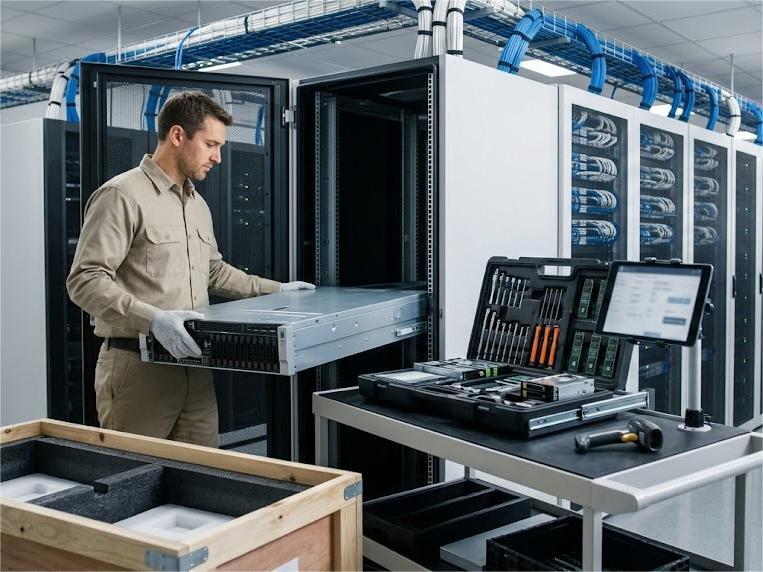
Smart hands support is an on-site technical service that places skilled technicians inside your data center or facility to perform physical tasks that cannot be executed remotely. These technicians operate under the direction of off-site engineers or IT teams, carrying out hands-on work with the precision and expertise your infrastructure demands.
Unlike a general maintenance crew, this type of team brings specialized knowledge of IT infrastructure, from network equipment and structured cabling to server hardware and storage devices. The scope of tasks these technicians can perform is broad, and understanding that scope is the first step to leveraging the service effectively.
Here is a breakdown of the core physical tasks covered:
- Hardware installation, racking, and stacking
Technicians install and set up servers, switches, and storage devices in data center racks, verifying functionality and ensuring proper integration with existing infrastructure. This includes unboxing equipment, physically mounting it, and confirming it is operational before signing off.
- Cable installation, labeling, and management
Proper cable management is critical to data center performance, and properly trained technicians handle the full scope of running cables, labeling connections, organizing pathways, and ensuring nothing is left to chance. Poor cabling is one of the most common sources of network instability, and a skilled smart hands team eliminates that risk from day one.
- Network equipment configuration and testing
Technicians can configure routers, switches, and access points on-site, following detailed instructions from remote engineers to ensure accurate setup. After configuration, they perform testing to confirm connectivity and performance meet the required specifications.
- Firmware and software updates on physical infrastructure
Keeping firmware current is essential for security and reliability, and technicians on the ground handle these updates directly on the hardware when remote access is unavailable or insufficient. They follow documented procedures to ensure updates are applied correctly without disrupting live operations.
- Power cycling and rebooting of servers, routers, and switches
When remote reboot commands fail or physical intervention is required, smart hands technicians perform power cycles quickly and safely to restore service. Fast physical response to these situations dramatically reduces downtime compared to waiting for in-house staff to travel to the site.
- Component replacement, including drives, memory, and interface cards
Failed components need to be swapped quickly, and smart hands technicians handle replacements for hard drives, memory modules, interface cards, and other hardware with precision. They follow manufacturer and client-specific procedures to ensure replacements are installed correctly and the system is verified operational before closing the ticket.
- Physical audits, asset inventory, and equipment documentation
Accurate asset tracking is the backbone of effective data center management, and on-scene teams conduct physical audits, tag equipment, scan serial numbers, and update documentation to keep records current. These audits are critical for compliance, capacity planning, and lifecycle management.
- Shipping, receiving, and unboxing of equipment
Smart hands technicians receive incoming shipments, verify contents against manifests, and transport equipment from the loading dock to the appropriate cage or cabinet. They also handle the packing and shipping of equipment being decommissioned or relocated, ensuring proper handling throughout.
- Environmental monitoring and visual inspections
Smart hands technicians conduct visual checks of data center conditions, including temperature sensors, cooling systems, and physical infrastructure integrity. These inspections catch potential issues before they escalate into outages.
- Firewall installation and basic configuration
Installing physical firewall appliances requires local presence on location, and technicians handle the physical installation and initial configuration under the direction of remote security engineers. Given the security implications, this work is carried out with strict adherence to client protocols and documented procedures.
- Decommissioning and removal of end-of-life equipment
When hardware reaches end of life, smart hands technicians safely power down, disconnect, and remove equipment from racks, following data sanitization procedures and client-specific decommissioning protocols. Proper decommissioning protects both security and compliance.
8 Reasons Smart Hands Services Give Your Data Center Operations an Unfair Advantage
These services do more than fill a logistical gap. They actively strengthen the performance, efficiency, and resilience of your data center operations. Organizations that deploy on-site IT support strategically gain capabilities that competitors relying solely on in-house staff simply cannot match at scale:
- Rapid response to physical issues without dispatching in-house staff
When a physical issue arises in a remote data center, response time is everything, and dispatching your own team takes time, money, and pulls resources away from other priorities. A team already on-site can respond immediately, containing the problem before it compounds into a larger outage.
- Access to specialized technicians without the overhead of full-time hires
Recruiting, training, and retaining skilled IT technicians is expensive, and the talent market for experienced data center professionals remains highly competitive. This model gives you on-demand access to vetted technicians with the exact expertise your infrastructure requires, without the ongoing cost of permanent headcount.
- Scalable support that grows or shrinks with your infrastructure demands
As your data center footprint expands or contracts, your support needs change accordingly, and on-the-spot coverage scales with you. You can increase coverage during peak deployment periods and scale back when demand stabilizes, keeping your support costs aligned with actual operational needs.
- Faster hardware installation and deployment across multiple sites
Multi-site hardware deployments are logistically complex, and coordinating in-house staff across multiple locations creates bottlenecks that slow timelines. Properly trained technicians can execute simultaneous installations across multiple data centers, compressing deployment windows and getting infrastructure online faster.
- Reduced downtime through proactive on-site monitoring and maintenance
Smart hands teams do not just respond to failures; they perform routine maintenance, inspections, and proactive checks that catch issues before they cause downtime. The cost of prevented downtime consistently outpaces the investment in proactive support.
- Consistent execution quality across global data center locations
Maintaining uniform standards across geographically dispersed data centers is one of the hardest challenges in large-scale IT infrastructure management. A smart hands provider with global reach and standardized processes delivers the same quality of execution in every location, eliminating the inconsistencies that arise when different local teams manage different sites.
-
Frees internal IT teams to focus on strategic initiatives instead of physical tasks
Every hour your engineers spend traveling to a remote data center to perform a physical task is an hour not spent on the strategic work that drives your business forward. Outsourced on-location support handles the physical layer so your in-house staff can concentrate on higher-value priorities.
- Strengthens vendor and third-party coordination by having a trusted on-site presence
Managing relationships with hardware vendors, carriers, and third-party service providers becomes significantly more effective when you have a knowledgeable technician physically present to coordinate handoffs, verify deliveries, and oversee vendor work. Smart hands technicians serve as your eyes and hands on the ground, ensuring vendor interactions go according to plan.
From Retail to Telecom: Which 8 Industries Reap the Greatest Returns on Smart Hands Support?
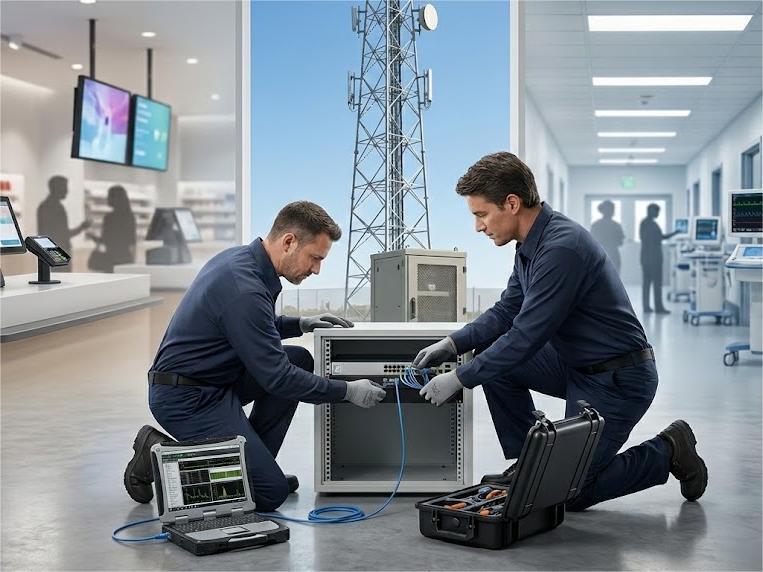
These services deliver value across virtually every sector that relies on distributed IT infrastructure, but certain industries experience returns that are disproportionately high given the physical complexity of their operations. The industries below have the most to gain from deploying a dedicated support team on the physical premises.
- Retail IT
Retail organizations operate sprawling networks of point-of-sale systems, digital signage, network equipment, and IoT devices spread across hundreds or thousands of store locations. On-site technicians handle hardware installations, break/fix support, and technology rollouts at scale, keeping customer-facing systems operational without requiring corporate IT teams to travel to individual sites.
When a POS system fails during peak trading hours, a rapid-response team on the ground is the difference between a minor interruption and a significant revenue loss.
- Telecom
Telecommunications companies manage vast physical infrastructure, towers, data centers, network nodes, and equipment rooms, spread across wide geographic areas that are often difficult to reach. On-site technical support for installation, maintenance, and troubleshooting of network equipment at these distributed sites keeps connectivity infrastructure operational around the clock.
The combination of remote hands directing and smart hands executing is especially powerful in telecom environments where remote diagnostics can identify an issue but physical intervention is always required to resolve it.
- Financial services
Financial institutions run mission-critical transaction systems where even brief downtime translates directly into lost revenue and regulatory exposure. Our technicians provide rapid on-location support for hardware failures, component replacements, and infrastructure maintenance while operating within the strict security and compliance frameworks that financial environments demand.
The ability to maintain uptime and security compliance simultaneously makes this type of support a high-value investment for banks, trading firms, and payment processors.
- Healthcare
Healthcare organizations depend on connected medical devices, electronic health record systems, and clinical networks that directly impact patient care. On-site technicians support the installation and maintenance of this infrastructure while adhering to strict regulatory compliance requirements, including HIPAA, that govern how data and physical systems are handled. In environments where downtime is not just costly but potentially dangerous, having expert smart hands support available on demand is a necessity.
- Manufacturing
Modern manufacturing facilities rely on interconnected technology systems, from warehouse management platforms and barcode scanners to industrial IoT sensors and automated production equipment, that must remain operational to sustain output.
On-the-spot teams support the installation, maintenance, and rapid repair of these systems, minimizing the operational disruptions that come with unexpected IT failures on the production floor. As manufacturers continue to adopt more sophisticated technology, the demand for skilled on-site IT support in these environments continues to grow.
- Managed service providers
MSPs face a fundamental challenge: their clients are spread across wide geographic areas, but their internal technical staff cannot be everywhere at once. Smart hands services allow MSPs to extend their geographic coverage and fulfill client commitments without the overhead of hiring full-time technicians in every market they serve. This model enables MSPs to scale their service offerings, take on more clients, and deliver consistent support quality regardless of location.
- Restaurant chains
Quick-service and full-service restaurant chains operate dense networks of POS systems, kitchen display systems, digital menu boards, and payment terminals that must function reliably during every service window. On-site technicians provide rapid break/fix support and technology installation at restaurant locations, resolving IT failures quickly enough to prevent service disruption during peak hours. For chains with hundreds of locations, having a support partner with broad geographic coverage eliminates the logistical nightmare of coordinating on-location visits across every market.
-
Colocation data centers and hyperscale facilities depend on smart hands services from third-party providers to support the diverse and constantly evolving needs of their tenants. From racking and stacking new customer equipment to performing physical audits and managing cable infrastructure at scale, skilled on-site technicians are the operational backbone of data center environments.
As data center demand continues to accelerate, the role of qualified, physically present support becomes increasingly central to keeping facilities running at the performance levels tenants expect.
Remote Hands vs. Smart Hands: Know The Difference + How They Support Your Operations?
Remote hands and smart hands are often mentioned together, and for good reason. They are complementary services that work in tandem to keep data center operations running smoothly, with each playing a distinct and essential role. Understanding the difference between them is the foundation for deploying both effectively.
Remote hands are engineers or technicians working from an off-site location who monitor systems, diagnose issues, and direct on-location activity. Smart hands are the technicians physically present at your facility who carry out the hands-on tasks that remote engineers cannot perform from a distance.
The two functions are not competing alternatives; they are two halves of a complete operational model. The table below outlines the key differences and how they complement each other.
|
|
Remote Hands |
Smart Hands |
|
Location |
Off-site, working remotely |
On-site, physically present at the data center or facility |
|
Primary Role |
Monitor, diagnose, and direct technical work |
Execute physical tasks as directed by remote hands or off-site engineers |
|
Typical Tasks |
Remote monitoring, troubleshooting, configuration, and guiding on-site technicians |
Cabling installation, racking and stacking, device installation, hardware swaps |
|
Technical Expertise |
Higher-level engineering and diagnostic knowledge |
Skilled technical execution of physical infrastructure tasks |
|
Decision Making |
Leads the troubleshooting and resolution strategy |
Executes on-site based on remote hands guidance and defined work orders |
|
When You Need Them |
When remote monitoring, configuration, or expert direction is required |
When physical access to infrastructure is necessary to complete the job |
|
Relationship |
Acts as the technical lead guiding on-site activity |
Acts as the physical extension of the remote team in the field |
|
How They Work Together |
Identifies the issue and directs smart hands on what needs to be done |
Carries out the physical work that remote hands cannot perform from a distance |
Don't Let Distance Slow Down Your Data Center: See What Kinettix Smart Hands Can Do
Kinettix deploys vetted technicians across 90+ countries, giving your operations the on-site expertise they need, wherever your infrastructure lives. Our Dispatch1® platform gives you real-time visibility into every technician activity, so you always know what's happening on the ground.
Reach out now to speak with the Kinettix team and discover how our services can strengthen your data center operations at any scale.
7 Steps to Deploy a Smart Hands Team That Performs Like an Extension of Your In-House Staff
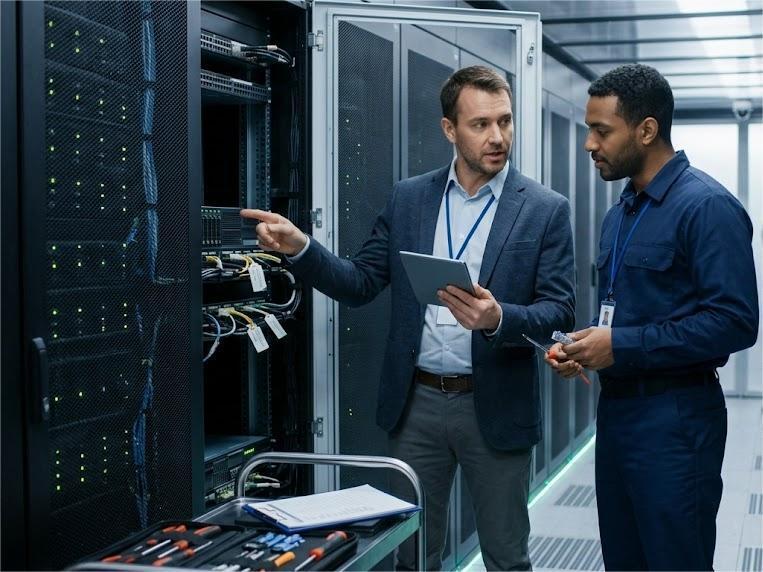
Getting the most out of on-site support requires more than selecting a provider and handing over a list of tasks. The organizations that get the most out of smart hands services follow a deliberate implementation process that sets clear expectations, builds operational alignment, and creates the feedback mechanisms needed to sustain performance over time.
- Assess your data center's physical support needs and identify coverage gaps
Start by conducting an honest evaluation of where your current in-house capabilities fall short, which sites lack adequate on-site coverage, which tasks are consuming too much of your internal team's time, and where response times are consistently too slow. This assessment forms the foundation for every decision that follows and ensures you engage a provider with a scope that reflects your actual operational needs.
- Define the scope of tasks and responsibilities for your smart hands team
Before engaging any provider, document precisely which physical tasks your contracted technicians will be responsible for, which tasks remain with your in-house staff, and where the boundaries lie. Ambiguity in scope is one of the primary causes of service failures, so investing time in clear definition at the outset prevents costly confusion later.
- Vet and select a smart hands provider with proven expertise in your technology stack
Evaluate prospective providers not just on price but on their demonstrated experience with the specific hardware, software, and infrastructure environments your data centers run. Ask for references, review case studies, confirm their geographic coverage aligns with your locations, and verify that their technician vetting and training processes meet your standards.
- Establish clear SLAs that outline response times, task expectations, and escalation paths
A well-constructed SLA is the operational backbone of a successful engagement, covering guaranteed response times, acceptable task completion windows, quality standards, and the process for escalating issues that fall outside the technician's scope. Ensure the SLA includes penalties for non-compliance and a clear dispute resolution process so both parties understand the consequences of falling short.
- Integrate the smart hands team into your existing workflows and communication channels
On-site technicians perform best when they are embedded into your ticketing systems, communication platforms, and operational workflows rather than operating in parallel as an external resource. Establish clear protocols for how tasks are assigned, how status updates are communicated, and how completed work is documented and reported back to your team.
-
Conduct onboarding and knowledge transfer so technicians understand your infrastructure
Take the time to brief your smart hands technicians on your specific infrastructure, your hardware vendors, network architecture, security protocols, and any site-specific requirements that affect how work gets done. The more context technicians have upfront, the more accurately and independently they can execute tasks without requiring constant remote guidance.
- Implement ongoing performance monitoring and feedback loops to maintain service quality
Establish regular review cadences from the start, weekly check-ins, monthly performance reports, and quarterly business reviews, to assess how well your team is performing against the standards defined in your SLA. Use these sessions to address issues proactively, recognize strong performance, and refine the scope of services as your operational needs evolve.
9 Smart Hands Pitfalls That Can Quietly Kill Your Data Center Performance (& How to Avoid Them)

On-site IT support delivers exceptional value when deployed correctly, but common mistakes can erode that value quickly and create operational problems that are difficult to unwind. These are the pitfalls that most frequently derail engagements, along with the specific steps to avoid them.
-
Choosing a provider based on cost alone rather than technical expertise and proven track record
Low-cost providers often cut corners on technician vetting, training, and quality assurance, and the cost of poor execution, failed installations, extended downtime, compliance violations, consistently exceeds any savings on the contract. Evaluate providers on depth of expertise, geographic coverage, client references, and demonstrated performance in environments similar to yours.
- Failing to establish clear SLAs, leading to inconsistent response times and unmet expectations
Without a detailed SLA in place, there is no objective standard against which to measure performance, and disagreements about what was promised become difficult to resolve. Define response times, task completion windows, quality standards, and escalation procedures in writing before the engagement begins, and ensure both parties have formally agreed to the terms.
- Keeping smart hands teams siloed from in-house staff, creating communication breakdowns
Treating on-site technicians as an external vendor rather than an operational partner leads to information gaps, duplicated effort, and delayed responses when issues arise. Integrate your team into your ticketing systems, communication platforms, and internal workflows from day one so they have the context and access they need to function as a genuine extension of your organization.
- Underestimating the onboarding investment needed for technicians to truly know your infrastructure
Expecting smart hands technicians to perform accurately from day one without proper onboarding is a setup for errors. Invest time in briefing your team on infrastructure specifics, security requirements, and site-level procedures, the upfront investment pays back in faster, more accurate execution throughout the engagement.
- Relying on smart hands for tasks that exceed their defined scope without proper escalation paths
Every engagement has boundaries, and pushing technicians to perform tasks outside their defined scope without a clear escalation path creates risk. Build a formal escalation process into your operating model so that out-of-scope situations are handled quickly and correctly without creating liability or operational disruption.
- Neglecting regular performance reviews, allowing small service gaps to compound over time
An engagement that runs without regular review tends to drift, small issues go unaddressed, standards slip incrementally, and what started as minor gaps eventually becomes a significant performance problem. Schedule structured performance reviews at consistent intervals and use objective SLA metrics to anchor the conversation.
- Over-dependence on the provider without maintaining enough in-house knowledge to manage the relationship
Outsourcing physical data center support does not mean outsourcing accountability, your internal team still needs to understand your infrastructure well enough to direct, evaluate, and course-correct your provider. Maintain internal expertise and document institutional knowledge so that a change in provider never leaves you operationally exposed.
- Skipping site-specific documentation, leaving technicians without the context needed to execute tasks accurately
Sending technicians into a site without detailed documentation, rack diagrams, cable maps, access procedures, equipment inventories, forces them to work from incomplete information, which increases the likelihood of errors and slows execution. Treat site documentation as a living asset and make it part of your standard handoff process for every engagement.
- Treating smart hands as a reactive fix rather than a proactive component of your broader operations strategy
Organizations that only engage on-site support in response to failures miss the far greater value of proactive maintenance, scheduled inspections, and planned deployments. Build this support into your operational planning from the start so your infrastructure benefits from consistent attention rather than periodic crisis response.
The Smart Hands Best Practices You'll Wish You Started Sooner
Successful engagements do not happen by accident, they are the result of deliberate practices that align your provider with your operational standards from day one. The organizations consistently getting the most out of their on-site IT support follow a common set of principles that separate high-performing partnerships from frustrating ones.
|
Best Practice |
Why It Matters |
|
Define clear scope and responsibilities upfront |
Prevents task creep and sets mutual expectations from day one |
|
Establish detailed SLAs with measurable KPIs |
Creates accountability and gives you a benchmark to evaluate performance |
|
Treat your smart hands team as an extension of in-house staff |
Improves communication, trust, and execution quality across the board |
|
Invest in thorough onboarding and infrastructure documentation |
Equips technicians with the context they need to work accurately and independently |
|
Schedule regular performance reviews and feedback sessions |
Catches service gaps early before they compound into larger operational problems |
|
Maintain internal knowledge of your own infrastructure |
Ensures you can manage the vendor relationship and make informed decisions |
|
Use a centralized platform to manage tickets and work orders |
Streamlines communication, tracking, and reporting across all smart hands activity |
|
Build escalation paths into your workflow from the start |
Ensures complex issues are resolved quickly without falling through the cracks |
6 Frequently Asked Questions About Smart Hands Support, Answered in Plain English
This type of service generates a consistent set of questions from IT leaders evaluating or managing these partnerships for the first time. The answers below address the practical concerns that tend to surface after the basics have been covered.
-
How do smart hands services integrate with existing IT service management platforms?
Most established providers support integration with widely used ITSM platforms, allowing work orders, tickets, and status updates to flow directly between your existing systems and your on-site team. Before engaging a provider, confirm which integrations they support natively and what is required to connect their operational platform to yours, a well-integrated workflow dramatically reduces manual coordination and speeds up task execution.
- How do smart hands services handle security and access control in sensitive data center environments?
Reputable providers operate within strict security frameworks, including technician background checks, access credentialing, escort protocols, and audit logging to ensure only authorized personnel perform work in your facilities. Before any technician enters a sensitive environment, confirm that your provider's security practices align with your specific compliance requirements, whether that involves SOC 2, HIPAA, PCI DSS, or other applicable standards.
- Can smart hands technicians work directly with third-party vendors on my behalf?
Yes, one of the practical advantages of having a vetted on-site team is their ability to interface with hardware vendors, carrier technicians, and other third parties who require physical access to your facility. Smart hands technicians can receive vendor shipments, escort vendor representatives, verify work performed by third parties, and serve as your local point of contact throughout vendor engagements, reducing the need for your own staff to be present.
- What happens when a smart hands technician encounters an issue outside their defined scope?
A well-structured engagement includes a documented escalation path that specifies exactly what happens when a technician encounters a situation beyond their scope, typically, they stop work, document what they found, and notify the appropriate remote engineer or client contact for guidance. This escalation process should be agreed upon before the engagement starts and tested during onboarding so that everyone involved knows how to handle out-of-scope situations without delay or confusion.
- Are smart hands services available on-demand or only through long-term contracts?
On-site support services are generally available through both models, on-demand for ad hoc tasks that arise without advance notice, and through longer-term agreements that provide dedicated coverage, priority response, and often more favorable pricing. The right model depends on your operational needs: organizations with predictable, recurring support requirements typically benefit from a contract structure, while those with sporadic needs may prefer on-demand access with the flexibility to engage only when required.
- How does geographic coverage affect smart hands service quality and response times?
A provider's geographic coverage directly determines how quickly a technician can reach your facilities and how consistent the quality of support will be across different locations. Providers with established technician networks in your key markets can deliver faster response times and more consistent execution than those who rely on one-off contractor arrangements, so confirming depth of coverage in every location you need to support is a critical evaluation criterion when selecting a partner.
Stop Letting Distance Slow Down Your Data Center: Partner with Us Today

Kinettix has built one of the most extensive smart hands networks in the industry, with vetted technicians deployed across 90+ countries and a proprietary platform that gives you real-time visibility into every task, every ticket, and every site. Our managed outcomes model means we do not only send technicians, we take accountability for the results, ensuring your data center operations stay on schedule, on standard, and fully supported regardless of where your infrastructure sits.
If your organization is ready to close the gap between remote visibility and on-site execution, Kinettix is the partner built to do it.
Contact us today to discuss your requirements and find out how we can deploy the right support model for your operations at any scale.